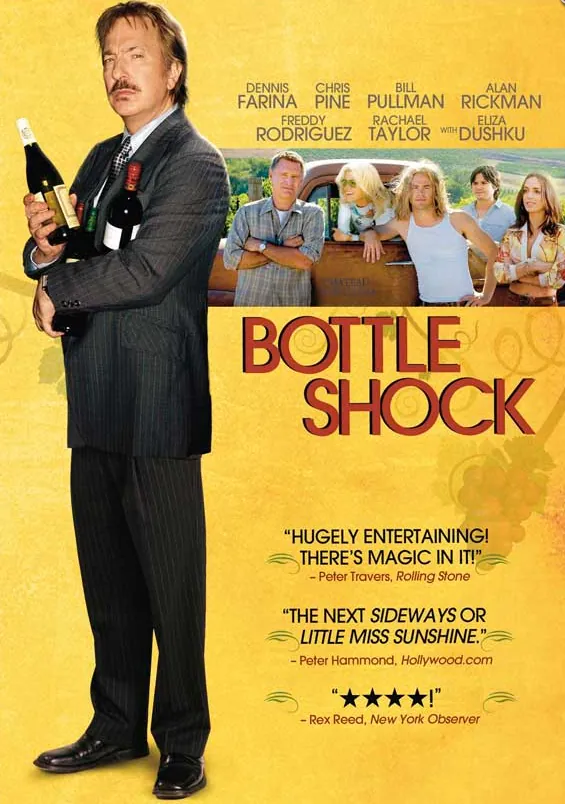
An English wine merchant in Paris, a lawyer trying his luck as a winemaker in the Napa Valley, and his son with the surfer haircut: “Bottle Shock” (2008) tells the back story of the most famous blind tasting in wine history as a sunny comedy. Alan Rickman plays Steven Spurrier, who in his Paris wine shop hits on the idea of pitting Californian wines against French ones for the American bicentennial. Bill Pullman is Jim Barrett, owner of Chateau Montelena in Calistoga, Chris Pine his son Bo.
What really happened
What really happened: on 24 May 1976, nine French judges at the Hotel Intercontinental in Paris tasted blind Chardonnays from California and Burgundy, then Cabernets from Napa and Bordeaux. Both times California won: the 1973 Chardonnay from Chateau Montelena and the 1973 Cabernet Sauvignon from Stag’s Leap Wine Cellars. The only journalist present was George Taber of Time magazine; his short piece turned the “Judgement of Paris” into a myth and Napa into a world-class region.
To drop at the apéro
Steven Spurrier, whom Alan Rickman plays so suavely, said the film contained “hardly a true word” and threatened to sue; the tasting itself really did happen, on 24 May 1976.
The film’s liberties
The film takes liberties, and Spurrier himself was not amused: he found “hardly a true word” in it and threatened to sue. The biggest gap concerns the man who actually made the winning wine: Miljenko “Mike” Grgich, Chateau Montelena’s Croatian-born winemaker and later founder of Grgich Hills, barely appears. The dramatic episode in which the Chardonnay suddenly turns brown and then clears again is cinema too: “bottle shock” or “bottle sickness” is a wine’s temporary muteness just after bottling or after transport, not a change of colour. And the tasting took place indoors, at white-clothed tables, not in a garden.
The cheek of the newcomers
The film is still worth watching because it gets one feeling right: the cheek with which a handful of newcomers took on centuries of tradition in the 1970s. Chateau Montelena and Stag’s Leap are still going, and a bottle of each of the two winning wines sits in the Smithsonian in Washington. For your own glass: a Chardonnay from California’s cooler sites, raised with little new oak, can still hold its own next to a Meursault today, ideally blind, as in 1976.