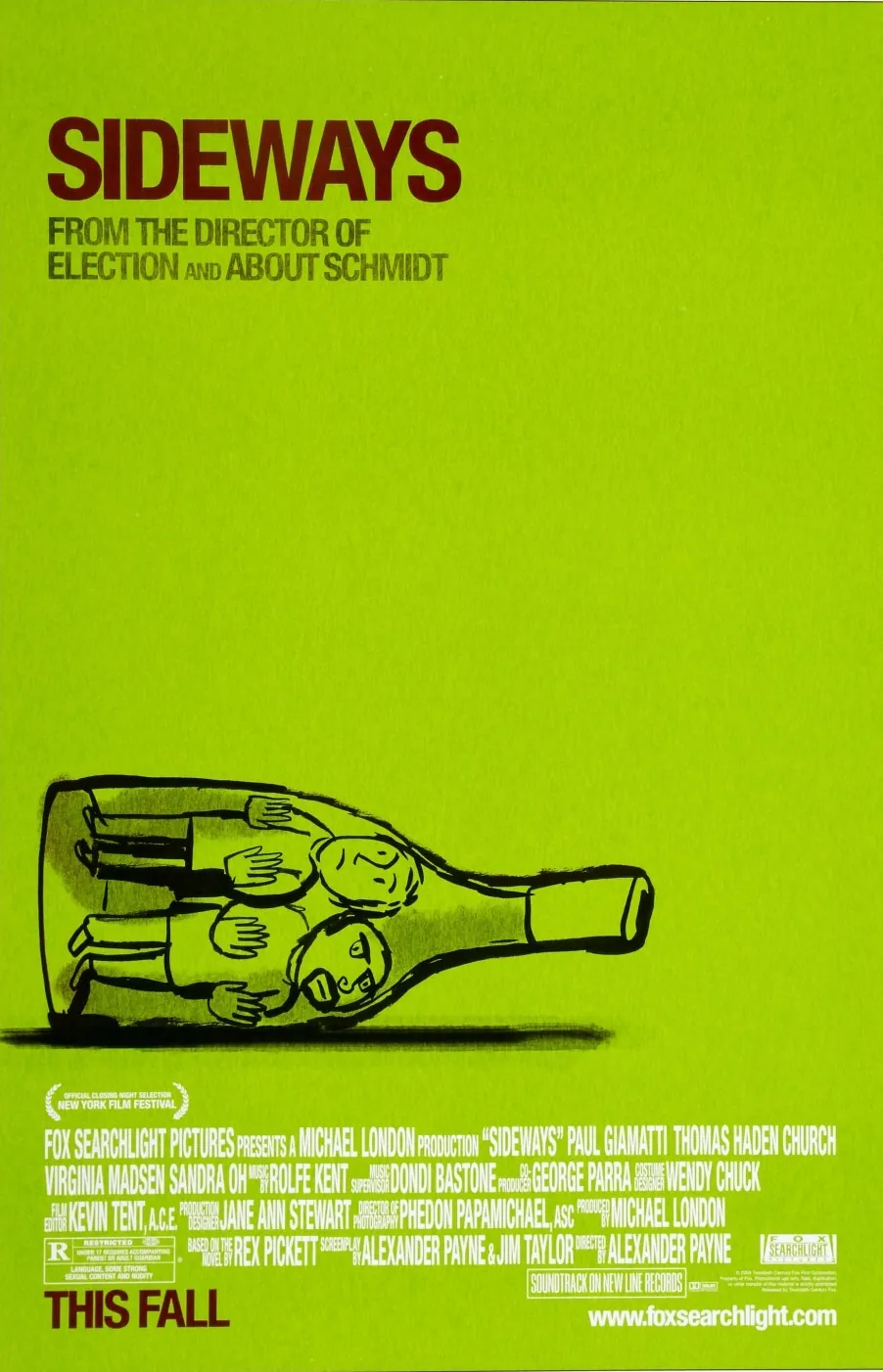
Two friends, one week, an old Saab convertible: Miles, a failed novelist and wine obsessive, and Jack, an actor days away from his wedding, drive up to the Santa Ynez Valley north of Santa Barbara. Miles wants to taste, Jack wants one last adventure. Alexander Payne’s “Sideways” (2004) is a comedy about male friendship and midlife crisis, and, in passing, the most influential wine film Hollywood has ever made.
A declaration of love
Its heart is a declaration of love. Miles explains to Maya why he worships Pinot Noir: a thin-skinned, temperamental grape that thrives only in a few sheltered places and needs patience, but whose aromas are more fleeting and more haunting than anything else. He is talking about himself, of course. The monologue is also sound oenology: Pinot Noir ripens early, is prone to rot and heat and loves cool sites, which is why it does so well in Burgundy, Oregon, New Zealand and the foggy Santa Ynez Valley, and why, as Pinot Noir or Blauburgunder, it is Switzerland’s leading red grape.
To drop at the apéro
Miles’s most sacred bottle, a 1961 Cheval Blanc, is made mostly of Cabernet Franc and Merlot, the very grape he curses so crudely in the film.
The curse on Merlot
The second famous line is a curse. Before a dinner, Miles makes clear that he will not be drinking any Merlot, in considerably cruder words. The effect was measurable: a Sonoma State University study found that in the years after the film’s release, US Pinot Noir sales rose by about 16 per cent while Merlot slipped slightly, mostly below ten dollars a bottle. Economists have called it the “Sideways effect” ever since; some think it overstated, since Merlot was already losing ground before the film. The film’s own punchline: the bottle Miles has been saving for years for the perfect moment is a 1961 Château Cheval Blanc from Saint-Émilion, a blend dominated by Cabernet Franc and Merlot.
Epilogue in the glass
The film doubles as a travel guide. The Hitching Post II in Buellton, where Maya waits tables, is real and bottles its own Pinot Noir; the region’s tasting rooms saw a boom in visitors after the release. At the 2005 Oscars “Sideways” had five nominations and won best adapted screenplay, from Rex Pickett’s novel. What remains for your own glass: Pinot Noir and Merlot are not rivals but two temperaments. Anyone who takes Miles’s monologue seriously tastes both blind, and may find that the cursed Merlot, from Ticino or from Pomerol, tastes surprisingly good.