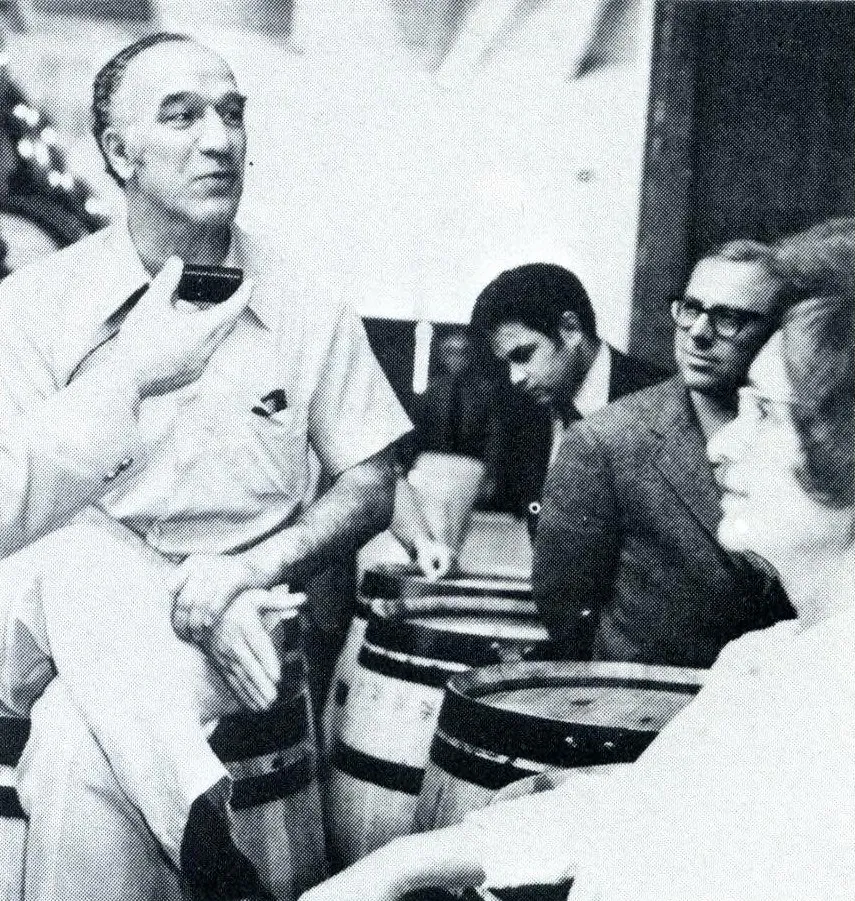
The story begins with a mink coat. In 1965 Peter Mondavi accused his brother Robert of wasting company money on the coat Robert’s wife had worn to a reception at the White House. The brothers, who ran the family winery Charles Krug in St. Helena together, came to blows, and Robert, then 52, was pushed out. A year later he opened his own winery in Oakville, with its landmark mission-style bell tower, the first major new winery in the Napa Valley since the end of Prohibition. The lawsuit over the family inheritance dragged on until 1976 and ended in a settlement in Robert’s favour.
A preacher, not a winemaker
Mondavi was not a winemaker in the classic sense but a preacher. He had seen in Europe that wine belongs with food, is part of culture and need not be sold in jugs. He travelled to Bordeaux and Burgundy, brought in French barriques and stainless steel tanks, experimented with cold fermentation and shared what he learned openly, even with competitors. His most famous marketing coup was Fumé Blanc in 1968: Sauvignon Blanc was regarded in California as a cheap sweet wine, so Mondavi made it dry, aged it in barrel and gave it a name that echoed Pouilly-Fumé. The wine was a hit, and the term is free for any producer to use today.
To drop at the apéro
Napa’s most famous winery owes its existence to a fistfight: in 1965 Robert Mondavi and his brother Peter came to blows over a mink coat, and Robert had to leave.
A handshake in Hawaii
In 1978 Mondavi and Baron Philippe de Rothschild of Château Mouton Rothschild met in Hawaii and decided to make a wine together. The first vintage, 1979, came from Mondavi’s grapes in the To Kalon vineyard in Oakville; in 1982 the project was named Opus One, and in 1991 it got its own winery across the road. It was the first joint venture between a Bordeaux first growth and a New World estate, and it proved that a Californian wine could sell at Bordeaux prices. Opus One is owned today half by Constellation and half by the Rothschild family.
A less glorious end
The end was less glorious. The 1993 stock market listing brought money and pressure, the family fell out over the strategy between mass brand and fine wine, and in 2004 Constellation Brands took over the company. Robert Mondavi died in 2008 at 94, having given tens of millions to culture, to the Robert Mondavi Institute at the University of California, Davis, and to the Copia food centre in Napa. For a Swiss wine lover he is the reason Napa Cabernet sits next to Bordeaux on the shelf, and the reason you can taste, eat and hear a concert at a winery today.