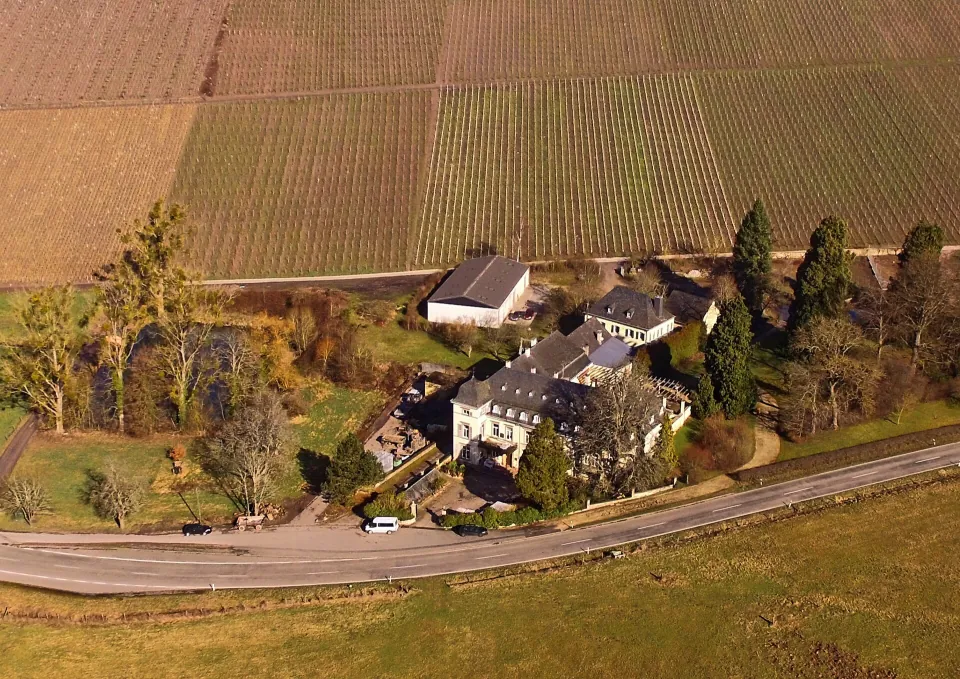
Every September the association of Germany’s top estates, the VDP, auctions its members’ rarest bottles in Trier, and every year the wine world watches one lot: Egon Müller’s Scharzhofberg Trockenbeerenauslese. In 2015 the hammer fell at about 12,000 euros for a bottle of the 2003, more than had ever been paid for a young German wine; only 18 full bottles were offered. There are more expensive wines, but hardly any white that fetches such prices so regularly at public auction.
The coolest slope on the Saar
The Scharzhof lies at Wiltingen on the Saar, a tributary of the Mosel, in one of the coolest wine regions of Europe. Behind the house rises the Scharzhofberg, a steep slope of weathered slate that stores the day’s warmth and gives it back to the vines at night. The estate owns about 8 of its 28 hectares, including old ungrafted vines. The soil gives the Riesling its breed: little alcohol, plenty of acidity, aromas of peach and herbs, and the ability to age for decades.
To drop at the apéro
At the VDP auction in Trier in 2015, one bottle of Egon Müller’s 2003 Scharzhofberger Trockenbeerenauslese fetched about 12,000 euros, a record for a young German wine.
A legacy of the Revolution
The story begins with the French Revolution. The hill belonged to the abbey of St Mary in Trier; secularised after the occupation of the Rhineland, it was bought at auction in 1797 by Jean-Jacques Koch, and through his daughter the property passed to the Müller family. Since 1991 Egon Müller IV has run the estate, the fourth of that name in a row. Little has changed, and that is the point: the wines ferment spontaneously in old large casks, and there is only Riesling.
What stands out is what is missing. While most top German estates now bottle their flagship as a dry Grosses Gewächs, the Scharzhof sticks to the fruity-sweet Prädikat pyramid: Kabinett at about eight per cent alcohol, Spätlese, Auslese, Beerenauslese, Eiswein and, in great years, the Trockenbeerenauslese from individually picked botrytised berries, of which there are often only a few dozen bottles. Residual sugar here is not a compromise but the preservative that gives the wine half a century of life. On the side, the family makes Riesling in Slovakia, at Château Belá, and in the Adelaide Hills of Australia.
A footnote on the name
For Swiss drinkers, a footnote on the name: the estate has nothing to do with Müller-Thurgau, the Riesling-Sylvaner of German-speaking Switzerland, which Hermann Müller from Thurgau bred at Geisenheim in 1882. To get to know the Saar style, start with the house’s Kabinett or its neighbours’: light, cool and, after an hour in the glass, astonishingly deep.