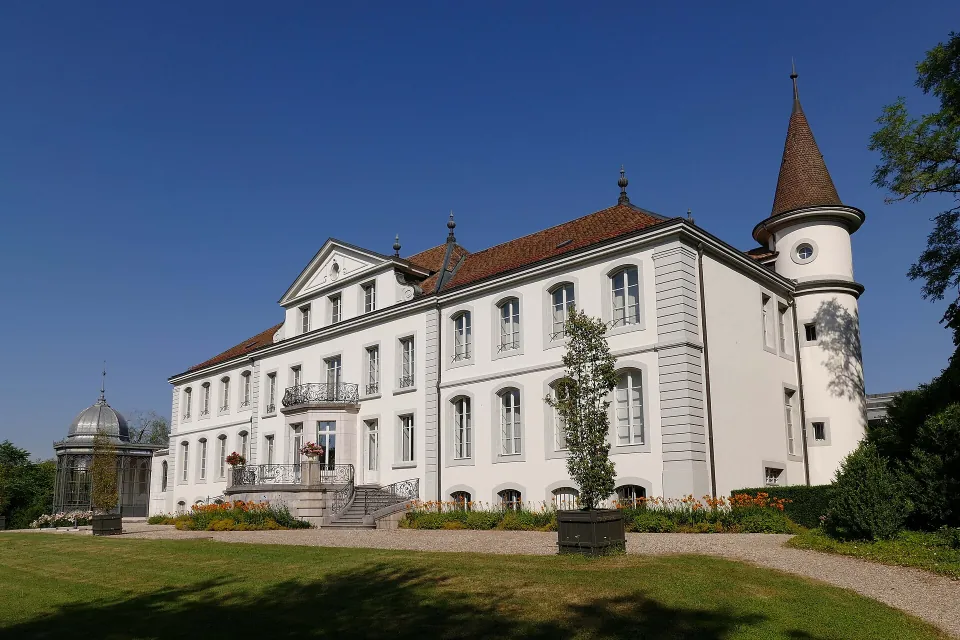
Whoever makes wine in Switzerland has very probably studied at Changins. The school was founded in Lausanne in 1948, backed by the French-speaking cantons, Bern and Ticino, and moved in 1975 to Changins above Nyon, right next to the federal research station, today Agroscope. The Bachelor has existed since 1999, the Master in viticulture and oenology since 2013, and the school belongs to the University of Applied Sciences of Western Switzerland, the HES-SO. Next door and at Wädenswil, Agroscope breeds the varieties that appear on Swiss labels: Gamaret and Garanoir from the 1970s, Divico, the fungus-resistant variety of 2013. In Switzerland, viticulture is also a science with an address.
From Geisenheim to Davis
The most famous Swiss grape, though, comes from Germany. Hermann Müller from Tägerwilen in Thurgau crossed Riesling with Madeleine Royale in 1882 at the Geisenheim school in the Rheingau; for a long time Silvaner was taken for the father, until DNA analysis set the family tree straight. Müller-Thurgau, long sold in German-speaking Switzerland as Riesling-Silvaner, has since been the most planted white grape of German-speaking Switzerland. Geisenheim, founded in 1872 and a university in its own right since 2013, is the German counterpart of Changins. Older still is Klosterneuburg near Vienna: founded in 1860, it counts as the oldest wine school in the world. There Fritz Zweigelt crossed Blaufränkisch with St. Laurent in 1922, and his grape is today Austria’s most planted red.
To drop at the apéro
Müller-Thurgau was bred at Geisenheim in 1882 by a man from Thurgau, and in 1997 Cabernet Sauvignon turned out, at Davis, to be the child of Cabernet Franc and Sauvignon Blanc.
Across the Atlantic, the University of California at Davis measured viticulture. Albert Winkler and Maynard Amerine divided California in the 1940s into five climate regions by heat summation, a system winegrowers around the world still quote. And in the 1990s Davis became the vine’s genetics lab: Carole Meredith and her team proved in 1997 by DNA profiling that Cabernet Sauvignon is the child of Cabernet Franc and Sauvignon Blanc, and two years later that Chardonnay, Gamay and a dozen other varieties descend from Pinot and the humble Gouais Blanc. The grape family trees on these knowledge pages go back to that work.
Two schools, two eras
In France two schools stand for two eras. Montpellier became the school of the phylloxera years in the 19th century, where people learnt to graft European vines onto American roots and where Pierre Galet later turned the study of grape varieties into a science. Bordeaux was the cellar school of the 20th century: Jean Ribéreau-Gayon and Émile Peynaud explained fermentation and ageing there, and their institute is today called the ISVV. Australia, finally, has trained winemakers since 1883 at Roseworthy near Adelaide, today on the university’s Waite campus, next to the research institute that gave the screw-cap revolution its scientific backing. The diploma on the cellar wall often says more about the wine than you would think.