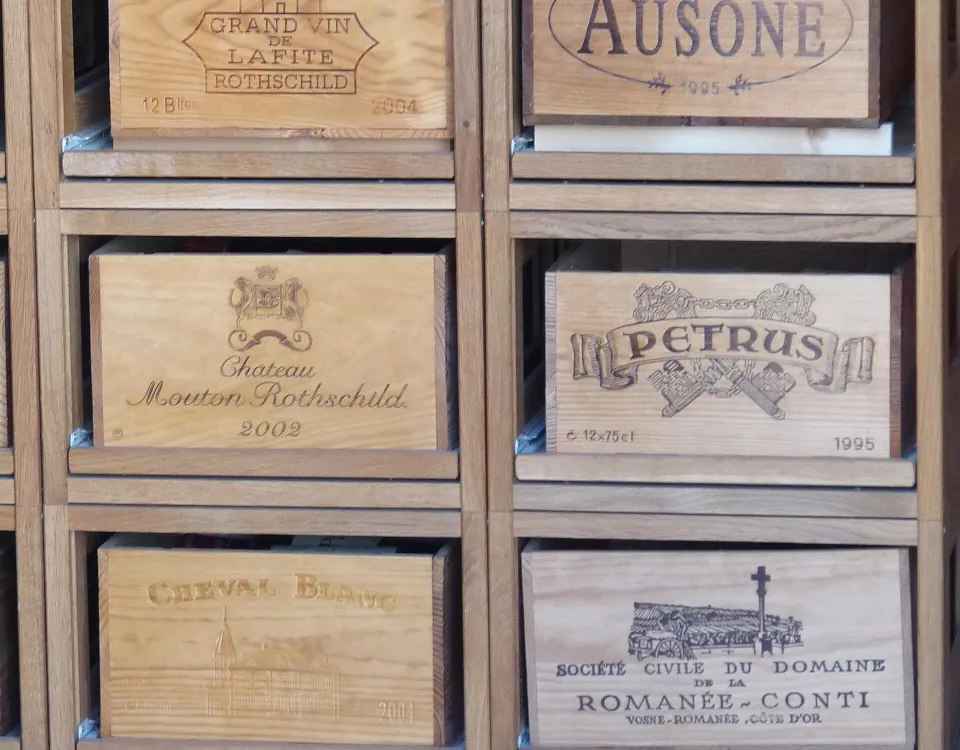
On 17 June 2018 in Geneva, the auction house Baghera/wines sold the last 1,064 bottles from the cellar of Henri Jayer, the Burgundy grower who had died in 2006, for 34.5 million francs, more than double the estimate; a vertical of fifteen magnums of Cros-Parantoux alone fetched over a million. Four months later in New York, Sotheby’s hammered a single bottle of Romanée-Conti 1945 for 558,000 dollars, a record for a standard bottle. Wine had become an asset class, and Switzerland was one of its trading floors.
An older machinery
The machinery is older than it looks. James Christie’s first auction, in London in December 1766, already included wine; today Christie’s, Sotheby’s, Acker and Zachys share the big sales, and Geneva and Zürich, with Baghera/wines and the older house Steinfels, are the Swiss addresses. Bordeaux sells “en primeur”: the châteaux offer a vintage in the spring after the harvest, two years before delivery, through négociants and courtiers, and the price moves with the critics’ first scores. Liv-ex, the London International Vintners Exchange founded in 2000, turned trade prices into indices such as the Fine Wine 100, so that wine can be charted like a share.
To drop at the apéro
In 2018 a single bottle of Romanée-Conti 1945 sold in New York for 558,000 dollars; the same year, a Burgundy cellar fetched 34.5 million francs in Geneva.
What moves the market
Three things move the market: scarcity (a grand cru is a few hectares and cannot grow), scores and fashion, and Asia. When Hong Kong abolished its wine duty in February 2008, it became the world’s biggest auction centre within a few years, and the prices of Château Lafite multiplied before falling back after 2011. Since then Burgundy has taken Bordeaux’s place at the top: tiny domaines, mythical names, a few hundred bottles. The earlier records read like a history of taste: an imperial of Cheval Blanc 1947 for 304,375 dollars at Christie’s in Geneva in 2010; a six-litre bottle of Screaming Eagle 1992 for 500,000 dollars at a charity auction in the Napa Valley in 2000.
The sober side belongs in every article. Fine wine costs money to keep (a bonded warehouse at 12 to 14 °C, insurance), earns nothing while it sleeps, can be hard to sell quickly, and attracts forgers: the Rudy Kurniawan affair showed how many fakes reached the best auction rooms. Provenance, a documented chain from the château to your cellar, is worth more than any score. And the indices measure the few hundred wines that trade; the other 99.9 per cent of wine is made to be drunk.
A market, not a recommendation
For the reader: this page describes a market, it recommends none. If you buy a case of a great vintage, the best return is still a dinner with friends in twenty years.