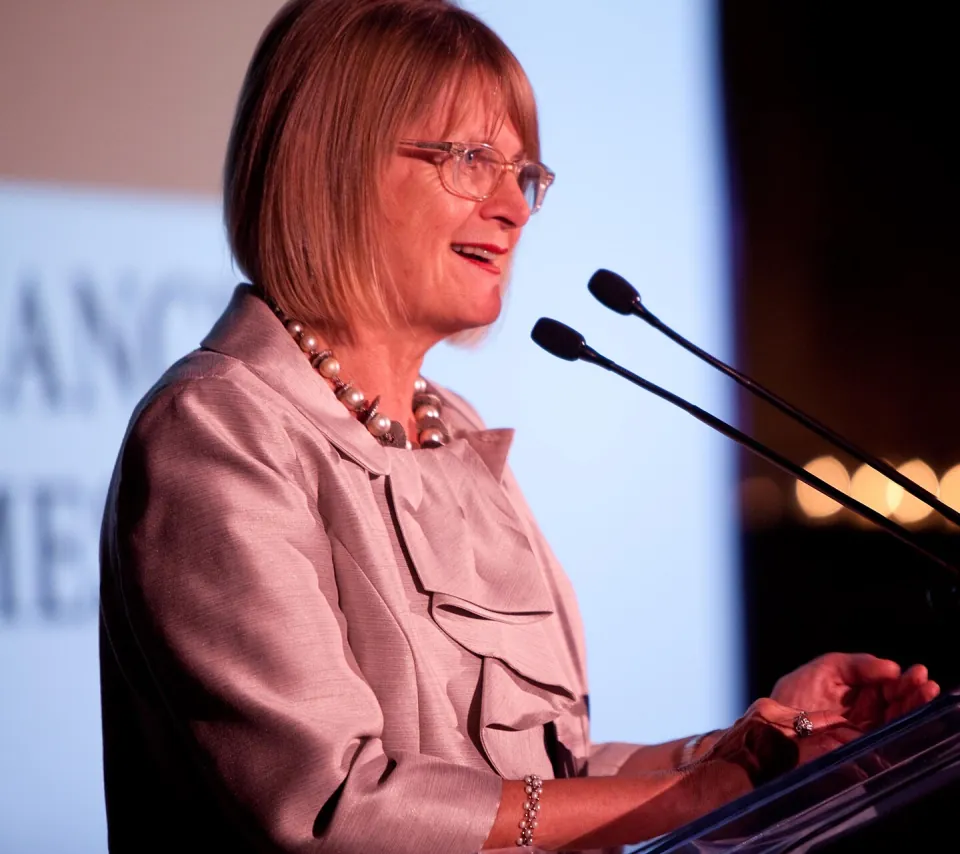
Jancis Robinson read mathematics and philosophy at Oxford, not oenology, and joined a wine and spirits trade magazine as an editorial assistant in 1975. What began as a job became a calling: she learnt to taste, travelled the vineyards and started writing the way she still writes today, clearly, curiously and without the fuss that keeps so many people away from wine. In 1984 she became the first person from outside the wine trade to pass the Master of Wine examinations; until then the title had belonged to the merchants.
From the Companion to the Atlas
Her life’s work is the reference books. “The Oxford Companion to Wine”, which she has edited since the first edition of 1994, is the encyclopaedia of wine: thousands of entries from abboccato to Zweigelt, written by specialists around the world and edited by her. “The World Atlas of Wine”, which Hugh Johnson invented in 1971, she has co-written with him since the 2001 edition; its maps are the reason so many wine drinkers can place a grand cru without ever having been there.
To drop at the apéro
In “Wine Grapes”, Jancis Robinson, Julia Harding and the Valais geneticist José Vouillamoz describe 1,368 grape varieties across almost 1,300 pages, with family trees that buried many a family legend.
1,368 grape varieties
In 2012 came “Wine Grapes”, written with Julia Harding and the Valais grape geneticist José Vouillamoz: 1,368 varieties grown somewhere in the world for wine, with their origins, synonyms and, thanks to DNA analysis, their family trees. The book buried many a family legend and showed how close the relationships are, from Gouais Blanc, the father of half of Europe’s grapes, to the Valais rarities Vouillamoz had studied.
Since 1989 she has written weekly in the “Financial Times”; since 2000 she has run her own website, where she and her team publish tens of thousands of tasting notes. She scores on the European 20-point scale, on which a 17 is already a very good wine, and distrusts any number without words. In 2003 the Queen made her an Officer of the British Empire; from 2004 to 2022 she advised the Royal Household’s wine cellar.
Read, don’t just count
What to take from her: read the notes, not just the points; trust your own palate; and reach for the grapes nobody knows. More than any other voice, Robinson has made sure that a Petite Arvine or a Completer is now treated as world heritage of wine rather than a curiosity.