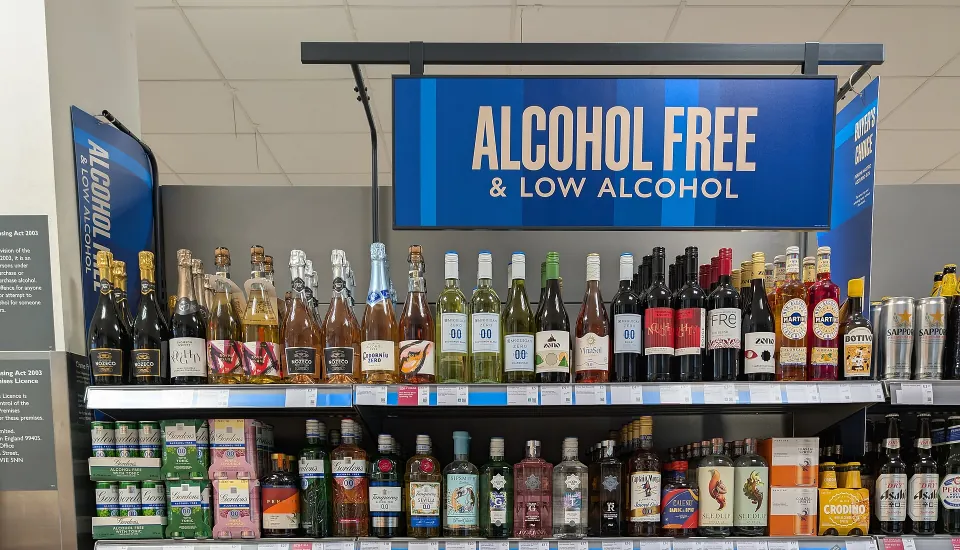
Dry January began in Britain in 2013 as a campaign of the charity Alcohol Concern; a decade later the shelves of Swiss supermarkets carry alcohol-free “wines” from Spain, Germany and Switzerland, and a growing number of bars pour a non-alcoholic sparkling by the glass. The category is small, but it is the fastest-growing corner of the drinks trade. The question is whether what is in the glass is still wine.
How the alcohol comes out
Technically it begins as wine: fermented grape juice, from which the alcohol is removed afterwards. Three methods dominate. Vacuum distillation lowers the boiling point so that alcohol evaporates at around 30 °C rather than 78 °C, which spares the aromas; the spinning cone column does the same in a thin film across rotating cones; reverse osmosis pushes the wine through a membrane that lets alcohol and water through and holds the rest back, then dilutes with water. Much of the aroma leaves with the alcohol, so producers catch it and add it back.
To drop at the apéro
A Mosel Riesling Kabinett has barely 8 % alcohol: the lightest “low-alcohol” wine was invented long before the laboratory.
The law follows the alcohol. In Switzerland, as in the EU, a drink may be called “alcohol-free” with at most 0.5 % vol. The EU’s wine market rules of 2021 created two further categories: “dealcoholised” wine with at most 0.5 % and “partially dealcoholised” wine with more than 0.5 % but less than the minimum of its category; wines with a protected designation may only be partially dealcoholised. Switzerland’s wine rules are its own, so read the label.
Why it often tastes thin
Why does it so often taste thin? Alcohol gives wine body, warmth and a touch of sweetness, and it carries aromas to the nose; take it out and a red can taste like cold tea. Sparkling wine suffers least, because bubbles and a little sugar fill the gap, and it is the style that sells best. Whites from aromatic grapes, Muscat and Riesling above all, come second; big reds remain the hardest case.
The alternative in the cellar
The alternative has been in the cellar for a century. A Mosel Riesling Kabinett has 7.5 to 8.5 % vol and a long life; Moscato d’Asti about 5.5 %; Vinho Verde and many Swiss Chasselas stop around 11 %. Low alcohol, with the grapes doing the work: for the reader who wants a lighter evening without a laboratory.