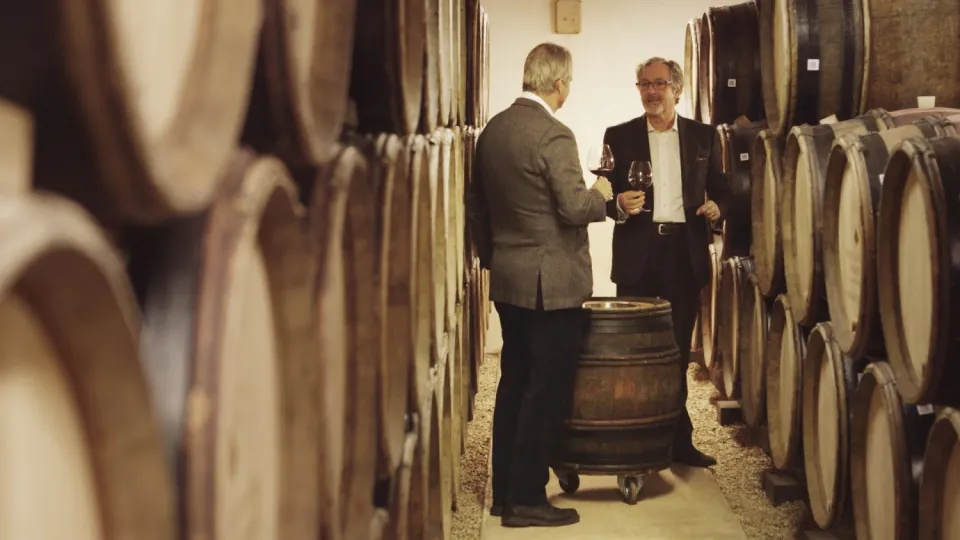
A young man from Los Angeles buys and sells old Burgundy for millions in the early 2000s, opens legendary bottles at dinners and is nicknamed “Dr. Conti” for his favourite domaine, the Domaine de la Romanée-Conti. “Sour Grapes” (2016) by Jerry Rothwell and Reuben Atlas tells the story of Rudy Kurniawan, the biggest wine forger ever convicted, as a thriller with real victims: collectors, auction houses and winemakers.
The crack of 2008
The crack appears in 2008. At Acker Merrall & Condit in New York, bottles from Domaine Ponsot come up for auction, Clos Saint-Denis from the vintages 1945 to 1971. Laurent Ponsot, head of the domaine, knows this is impossible: his family has only bottled Clos Saint-Denis since 1982. He flies to New York and has the lots withdrawn in the saleroom. From then on he gathers evidence for years, in parallel with the billionaire Bill Koch, who had found fakes in his own cellar and paid his own investigators. In March 2012 the FBI searches Kurniawan’s house in Arcadia near Los Angeles and finds a forger’s kitchen: thousands of labels, old empty bottles, corks, sealing wax and handwritten recipes for mixing a “1945” from younger, cheaper wines.
To drop at the apéro
Kurniawan’s “1945 Ponsot Clos Saint-Denis” had one flaw: the domaine has only bottled that wine since 1982, and Laurent Ponsot flew to New York to say so in the auction room.
How to fake a 1945
Along the way the film explains how wine forgery works: old vintages are rare, expensive and almost impossible to check blind, because hardly anyone knows the original. Kurniawan exploited that by buying genuine old bottles as templates and serving his blends at dinners where they were praised. In 2013 he became the first person convicted of wine fraud in a US federal court, sentenced in 2014 to ten years; released at the end of 2020, he was deported to Indonesia in 2021. The problem was not new: as early as the 1980s the German Hardy Rodenstock sold Bordeaux bottles said to have belonged to Thomas Jefferson, whose authenticity was never proven, as told in Benjamin Wallace’s “The Billionaire’s Vinegar” (2008).
The trade arms itself
The trade has armed itself since. Laboratories date wine using caesium-137, an isotope that only entered the environment with the nuclear tests after 1945: a “1929” bottle containing caesium is a fake. Great domaines fit their bottles with tamper-proof seals and codes, auction houses check the chain of provenance. For ordinary drinkers the lesson is simple and reassuring: forgers care about bottles costing several thousand francs. Anyone who buys their Burgundy from the grower or from a merchant with a name to protect is drinking the real thing.