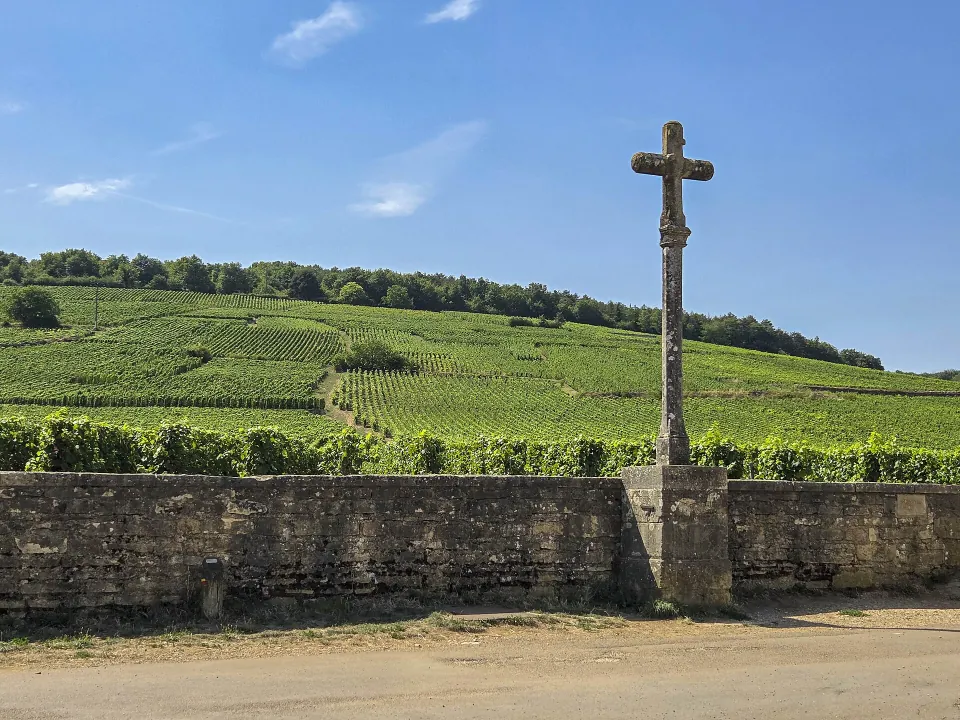
On 13 October 2018, at Sotheby’s in New York, a bidder paid 558,000 dollars for a single bottle of 1945 Romanée-Conti. In March 2026 the same bottle came up again at Acker in New York and fetched 812,500 dollars, the record for a standard-sized bottle of wine. The vintage is a myth because it very nearly did not exist: frost and hail left only about 600 bottles in 1945, and the same year the old ungrafted vines that had survived phylloxera were pulled up. From 1946 to 1951 there was no Romanée-Conti at all; 1952 is the first vintage from the young vines.
Two monopoles at Vosne
Domaine de la Romanée-Conti, DRC to the wine world, sits in Vosne-Romanée on the Côte de Nuits. Its heart is two monopoles, vineyards it owns outright: Romanée-Conti, a grand cru of only about 1.8 hectares, and La Tâche, about 6 hectares. Add parcels of Richebourg, Romanée-Saint-Vivant, Grands Échezeaux and Échezeaux, a piece of Montrachet for the house’s only white, and Corton since 2009. Everything is Pinot Noir except the Chardonnay of the Montrachet. The name comes from the Prince de Conti, who bought the vineyard in 1760, legend says, from under the nose of Madame de Pompadour.
To drop at the apéro
There is no Romanée-Conti at all from 1946 to 1951: the old vines were pulled up in 1945, and the young ones were only allowed their first vintage in 1952.
Since 1942 the domaine has belonged to two families, de Villaine and Leroy, today Leroy/Roch, who run it together. Its face for half a century was Aubert de Villaine, co-director from 1974 to 2022, who also sat on the jury of the 1976 Judgement of Paris. The vineyards have been farmed biodynamically since the 2000s, ploughed partly by horse, yields are tiny and the wines are sold by allocation only, the top crus in mixed cases with the others. You practically never see them on a shelf.
A blackmailer in the vineyard
In the winter of 2009–2010 the domaine received threatening letters: a blackmailer demanded a million euros or he would poison the vines of Romanée-Conti, and as proof he had really drilled into two of them. The police set a trap at the handover in February 2010. That DRC’s wines are also the forgers’ favourite target is told on the page about “Sour Grapes”.
What is left for the glass
For most of us DRC remains a wine to read about rather than to drink. To understand what makes the Pinot Noir of Vosne-Romanée so coveted, drink the neighbours in the village, a Village or a Premier Cru, and compare it with a Pinot Noir from the Bündner Herrschaft, not called the “Burgundy of Switzerland” for nothing.