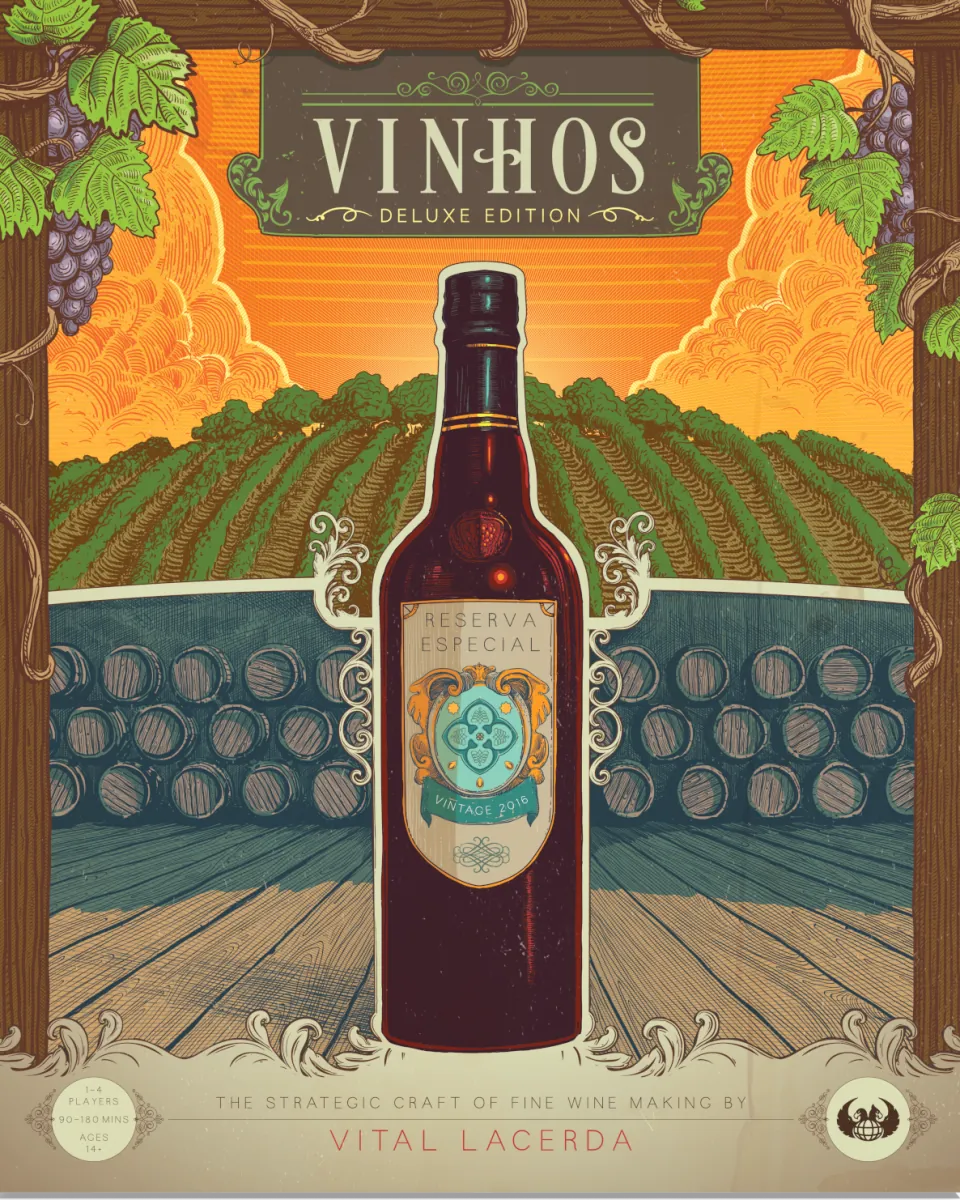
Twelve moves, and not one more. “Vinhos” lasts six years, and each year every player has two actions: buy vineyards, build wineries, hire oenologists and farmers, sell or export wine, recruit experts, send a wine to the fair. Every decision rules out two others. The game by the Portuguese designer Vital Lacerda came out in 2010; “CO₂”, “The Gallerist” and “Lisboa” followed and sealed his reputation for heavy, tightly interlocking strategy games. In 2016 a Deluxe Edition appeared, illustrated by Ian O’Toole, with two rulebooks in one box: the original “2010 Reserve” and the leaner “Special Vintage 2016”.
Nine regions, nine rules
The board is a wine map of Portugal, and each region has a quirk that says something true. In the Minho, home of Vinho Verde, you cannot build a cellar: these wines are drunk young. In the Douro you receive Porto tiles that lift a Douro wine, a nod to the port that grows on the river’s steep slopes. The Dão gives you a free cellar, because its wines are known for their ageing potential. In the Alentejo, the hot plains of the south, the region’s renown counts double, and whoever starts in Setúbal gets two experts, a bow to Moscatel de Setúbal. Lisboa, once Estremadura, gives a winery, the Ribatejo on the Tagus a farmer, Trás-os-Montes scores at the fair and the Algarve when you sell.
To drop at the apéro
The money in Vinhos is called bagos, Portuguese for the berries of a bunch, and in the Minho you may not build a cellar: Vinho Verde is drunk young.
Fairs and vintages
The fairs set the pace. After the third, fifth and sixth years the Feira Nacional do Vinho Português is held. There the value of the wine counts, and so do the experts you bring along, sorted by appearance, aroma, taste and alcohol content, in other words the stages of a tasting. Vintage tiles change quality from year to year, and in a bad year an estate can come away empty-handed. Victory points come mostly from fairs and exports; you pay in bagos, the Portuguese word for the berries of a bunch.
The games shelf
Four wine games from family game to heavyweight, and what they teach about wine.
-
Vignobles2017
Fabrice Arcas, Guillaume Peccoz · Ludocom
- 2–4 players
- about 45 min
- Family game
south-west France, with all of France on the back
the wine trade with a region’s appellations
-
Viticulture2013 · Essential Edition 2015
Jamey Stegmaier, Alan Stone · Stonemaier Games
- 1–6 players
- 60–90 min
- Medium weight
an old estate in ItalyTuscany
the vine year: plant, harvest, make wine, age, deliver
-
Grand Cru2010
Ulrich Blum · eggertspiele
- 2–5 players
- about 90 min
- Medium weight
an estate built on credit
loans, investments and the cellar, until the last loan is repaid
-
Vinhos2010 · Deluxe Edition 2016This article
Vital Lacerda · Eagle-Gryphon Games
- 1–4 players
- 90–180 min
- Heavy game
Portugal, nine regionsVinho VerdeDouroAlentejo
Portugal’s regions, oenologists and the wine fair
Players and length as the publishers give them; family, medium or heavy is the editors’ reading.
What it teaches about Portugal
After a few games of Vinhos you know the wine map of Portugal better than many a restaurant wine list. That is its real value for wine lovers: with its native grapes, from Touriga Nacional in the Douro to Alvarinho in the Minho, Portugal is one of the most varied wine countries in Europe. For the Deluxe Edition there are the islands, Madeira and the Azores, as small expansions. A red Douro, made from the same grapes as port, suits the game, or a Vinho Verde for the first years, before the fairs get serious. One evening is enough for a game; learning the rules takes a second.