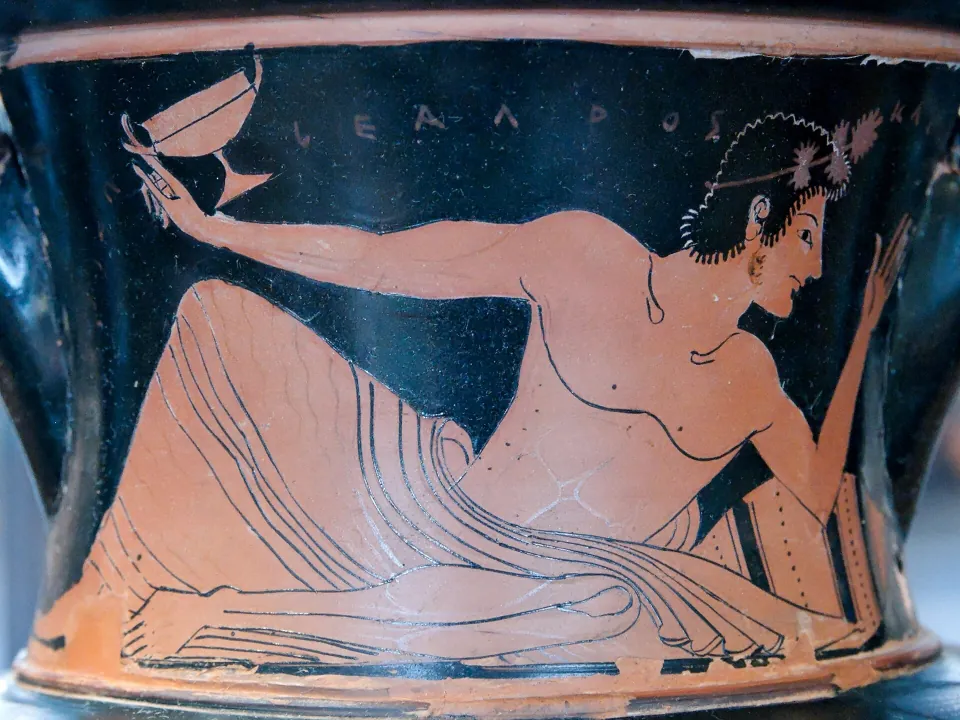
Wine and games have gone together since antiquity. At the Greek symposium, guests played kottabos: half reclining, they flung the last of the wine from their shallow cup at a small disc balanced on a bronze stand, dedicating the throw to the one they loved. If the disc fell with a bright ring, it was a good omen. Today the wine sits on the games table instead of flying across the room. Hundreds of board games tell of vines, cellars and the wine trade, from the simple quiz to the strategy game that fills a whole evening. Most are forgotten; a handful are worth it, not least because they teach a surprising amount about the craft along the way.
From vine to order
Modern wine games are almost all engine-builders: you start with a modest estate and expand it turn by turn. The benchmark is “Viticulture” by Jamey Stegmaier and Alan Stone (2013), set in Tuscany: you plant vines, harvest, make wine, age it in the cellar and fill orders. The game knows real grapes, from Sangiovese to Chardonnay, and knows that you need a large cellar before you can make sparkling wine. Those who like a heavier game reach for “Vinhos” by the Portuguese designer Vital Lacerda (2010, reissued 2016): nine wine regions of Portugal, oenologists and a wine fair where experts in appearance, aroma, taste and alcohol make the difference. Lighter, and French, is “Vignobles” (2017), invented by two primary school teachers: you trade the wines of south-west France.
To drop at the apéro
The oldest wine game is Greek: at kottabos, guests at a symposium flung the last of the wine from their cup at a target and dedicated the throw to the one they loved.
Money, weather and luck
Other games take the economics seriously. In “Grand Cru” by Ulrich Blum (2010) everyone starts with bank loans, and the game ends as soon as someone has paid back their last one; whoever then has the most money wins. Vinhos lets vintage tiles decide quality, as the weather does in real life: in a bad year an estate can come away with nothing. What none of these games captures is taste. For that there is a genre of its own: trivia and tasting games, aroma kits such as Le Nez du Vin and home-made nose games in which you sniff glasses blind.
The games shelf
Four wine games from family game to heavyweight, and what they teach about wine.
-
Vignobles2017
Fabrice Arcas, Guillaume Peccoz · Ludocom
- 2–4 players
- about 45 min
- Family game
south-west France, with all of France on the back
the wine trade with a region’s appellations
-
Viticulture2013 · Essential Edition 2015
Jamey Stegmaier, Alan Stone · Stonemaier Games
- 1–6 players
- 60–90 min
- Medium weight
an old estate in ItalyTuscany
the vine year: plant, harvest, make wine, age, deliver
-
Grand Cru2010
Ulrich Blum · eggertspiele
- 2–5 players
- about 90 min
- Medium weight
an estate built on credit
loans, investments and the cellar, until the last loan is repaid
-
Vinhos2010 · Deluxe Edition 2016
Vital Lacerda · Eagle-Gryphon Games
- 1–4 players
- 90–180 min
- Heavy game
Portugal, nine regionsVinho VerdeDouroAlentejo
Portugal’s regions, oenologists and the wine fair
Players and length as the publishers give them; family, medium or heavy is the editors’ reading.
Borrow before you buy
Anyone who wants to try a game before buying it is well served in Switzerland: some 350 games libraries in Switzerland and Liechtenstein, the ludothèques, lend games the way a library lends books. For a games night with wine, the rule is the same as for a menu: the light game first, then the heavy one, and the glass on a side table, because cards and red wine do not mix. And for anyone with a phone to hand between two games: the Weinquiz apéro round is a wine game too, for up to six people, one question each in turn.