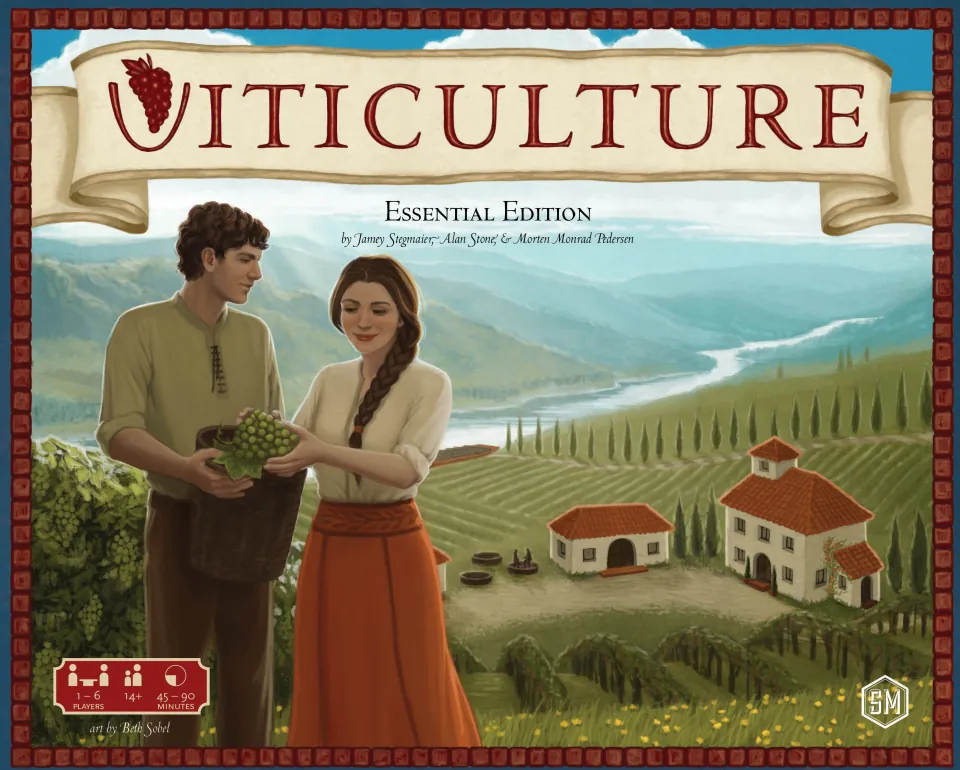
A year has four seasons, and each has its work. In spring you decide how early to get up: early risers choose first, late sleepers get a better bonus in return. In summer you plant vines, show visitors round the estate and sell grapes; in autumn guests arrive; in winter you harvest, make wine and deliver. That is how “Viticulture” runs, the board game by Jamey Stegmaier and Alan Stone, funded on Kickstarter in 2012 and published in 2013. You take over a modest estate in Tuscany and turn it into the best in the area; whoever reaches 20 victory points ends the game at the close of that year.
What the game gets right
A surprising amount of it is true. The vine cards carry real grapes, and some need groundwork: Sangiovese and Malvasia grow unaided, Pinot, Syrah and Trebbiano need a trellis, Merlot and Sauvignon Blanc irrigation, Cabernet Sauvignon and Chardonnay both. Grapes and wines are tokens worth 1 to 9, and each year they gain a point, the wine only as far as the cellar allows: for the better wines you need first a medium, then a large cellar. Sparkling wine is made from two red grapes and one white, a little like Champagne, which marries Pinot Noir and Meunier with Chardonnay.
To drop at the apéro
Viticulture’s “blush”, made from one red and one white grape, has a Swiss cousin: Schiller, a wine from black and white grapes processed together.
Where the cellar cheats
The rest is game. In Viticulture every wine in the cellar improves year after year; in reality most wine is made to be drunk young, and only a few bottles gain with time. The game’s rosé, the “blush”, is made from one red and one white grape. In the EU a rosé may generally not be made by blending red and white wine, sparkling wine being the exception. Switzerland, though, has a tradition that proves the game right: Schiller is a wine from black and white grapes processed together. Irrigation, too, is just another building in the game; in many European appellations it is restricted, and in dry Valais the bisses have carried water to the vines for centuries.
The games shelf
Four wine games from family game to heavyweight, and what they teach about wine.
-
Vignobles2017
Fabrice Arcas, Guillaume Peccoz · Ludocom
- 2–4 players
- about 45 min
- Family game
south-west France, with all of France on the back
the wine trade with a region’s appellations
-
Viticulture2013 · Essential Edition 2015This article
Jamey Stegmaier, Alan Stone · Stonemaier Games
- 1–6 players
- 60–90 min
- Medium weight
an old estate in ItalyTuscany
the vine year: plant, harvest, make wine, age, deliver
-
Grand Cru2010
Ulrich Blum · eggertspiele
- 2–5 players
- about 90 min
- Medium weight
an estate built on credit
loans, investments and the cellar, until the last loan is repaid
-
Vinhos2010 · Deluxe Edition 2016
Vital Lacerda · Eagle-Gryphon Games
- 1–4 players
- 90–180 min
- Heavy game
Portugal, nine regionsVinho VerdeDouroAlentejo
Portugal’s regions, oenologists and the wine fair
Players and length as the publishers give them; family, medium or heavy is the editors’ reading.
A publisher that grew with it
Viticulture was the first game from Stonemaier Games of St. Louis, which went on to publish “Scythe” and “Wingspan”, the 2019 Kennerspiel des Jahres, Germany’s award for games for experienced players. The “Tuscany” expansion, funded in 2014 and reissued in 2016 as an Essential Edition, adds a larger board on which you need 25 points; “Viticulture World” (2022) turns it into a co-operative game. Since 2015 the Essential Edition has included a solo variant against a card-driven opponent, the “Automa”. A Tuscan Sangiovese suits the game; the Swiss answer to the blush would be a Schiller from eastern Switzerland.