In 1972 the Vaud house Hammel bottled a Chasselas under an aluminium screw cap, after two years of trials: the grape was suffering badly from cork taint, and Swiss growers became the first in Europe to turn the cap in earnest. The rest of the wine world called it a closure for cheap wine for another thirty years. Then, in 2000, a group of Riesling producers in Australia’s Clare Valley switched their whole vintage, New Zealand launched its Screwcap Initiative in 2001, and today about nine in ten New Zealand wines are sealed that way.
An enemy with a name
The enemy has a name: 2,4,6-trichloroanisole, TCA, a molecule that forms when fungi in the cork meet chlorine compounds. A few nanograms per litre, a few drops in a swimming pool, are enough to make a wine smell of wet cardboard and lose its fruit. In the 1990s estimates ran to one tainted bottle in twenty; the cork industry has since cleaned up its processes, and Amorim, the Portuguese market leader, has screened every cork of its top lines one by one for TCA since 2016 (NDtech). The rate today is far lower, but not zero.
To drop at the apéro
Switzerland was Europe’s screw-cap pioneer: the Vaud house Hammel sealed a Chasselas with one in 1972, long before Australia and New Zealand.
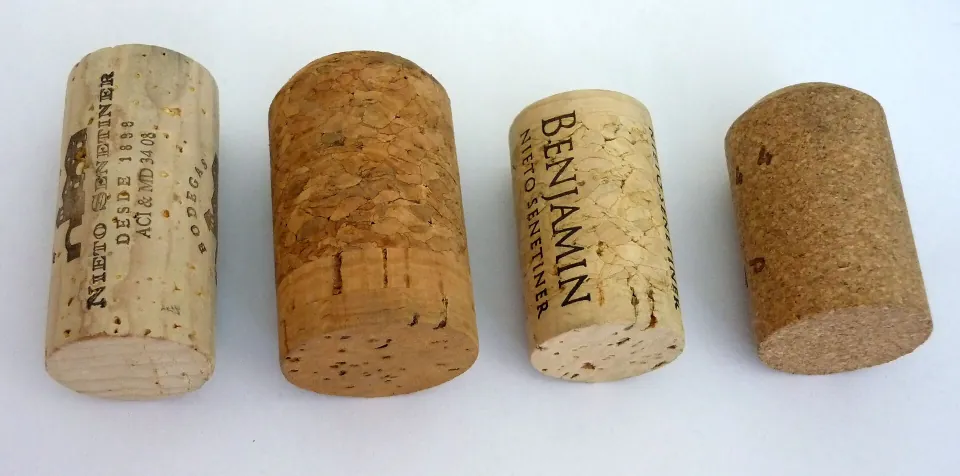
Cork itself is a marvel: the bark of the cork oak, Quercus suber, stripped by hand every nine years from trees that are at least 25 years old and live for about two centuries. Portugal grows about half of the world’s cork, Spain most of the rest, and the cork forests of the Alentejo are a protected landscape. Natural cork lets a trickle of oxygen through; many believe this is what lets a Bordeaux or a Barolo age gracefully for decades.
The alternatives multiply
The alternatives have multiplied. Diam, an agglomerated cork washed with supercritical CO2, promises no TCA and comes in versions for two, ten or thirty years. Glass stoppers (Vinolok) and synthetic corks occupy niches. The screw cap, developed in France in the late 1950s and marketed as Stelvin, lets very little oxygen in; critics speak of “reduction”, a struck-match or rubbery note in some wines, and ask whether great reds can age under it. Long-term trials in Australia say yes, more slowly. Coravin, launched in 2013, sidesteps the question by pushing a needle through the cork and pouring under argon, so that a bottle can be sampled for months.
Smell before you judge
For the reader: a screw cap says nothing about quality, a cork nothing about ambition. Smell the glass; if it smells of damp cellar, it is the cork, not you. Send it back.