In a Zürich wine bar the list says “nature” and the glass is cloudy, slightly fizzy and smells of cider, yeast and red berries. Nobody is cheating you: this is what wine looks like before the cellar’s toolkit is applied. Natural wine has no legal definition anywhere, but its followers agree on the idea: organic or biodynamic grapes picked by hand, fermentation with the wild yeasts that arrive on the fruit, nothing added and nothing taken away, except perhaps a small dose of sulphur before bottling, and often not even that.
A godfather in Beaujolais
The movement has a godfather and a home. Jules Chauvet (1907–1989), a négociant and chemist in La Chapelle-de-Guinchay in Beaujolais, studied fermentation without added sulphur in the 1950s and 1960s and taught a handful of neighbours. Marcel Lapierre in Morgon followed him from the 1980s, with Jean Foillard, Guy Breton and Jean-Paul Thévenet; their American importer Kermit Lynch called them the “Gang of Four”. From the bistros of Paris the style spread to the Loire, the Jura, Italy and Austria and, in the 2010s, to the bars of Zürich, Geneva and Lausanne.
To drop at the apéro
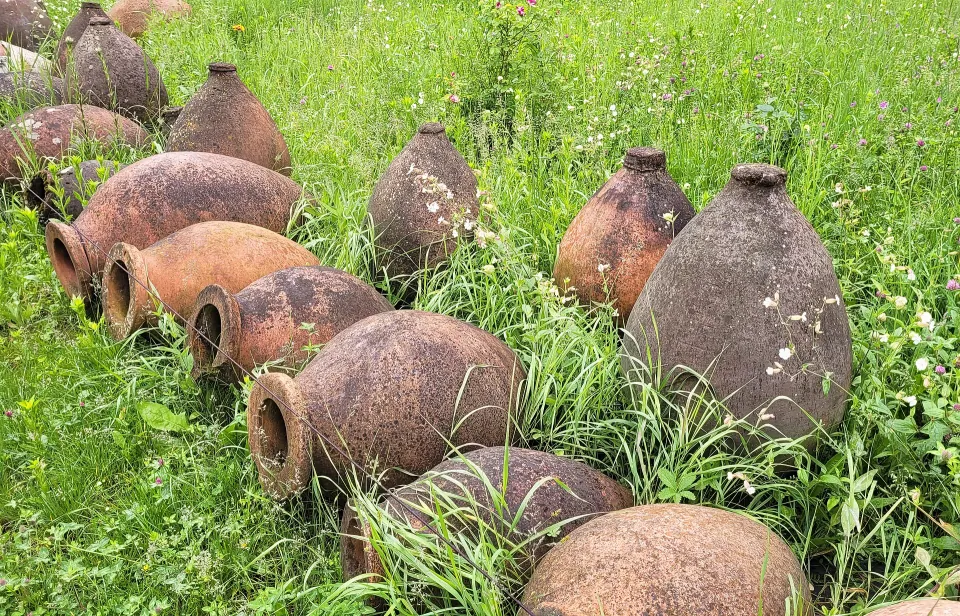
Orange wine contains no oranges: it is white wine fermented on its skins like a red, as Georgia has done in clay vessels for about 8,000 years.
Two travelling cousins
Two cousins travel with it. Orange wine is white wine made like a red: the skins stay in the fermenting juice for days or months, the colour turns amber, the texture gains grip. Georgia has done it for millennia in buried clay vessels, the qvevri; Josko Gravner and Stanko Radikon in Oslavia in Friuli revived the method in the late 1990s. Pét-nat, short for pétillant naturel, is the oldest way to make sparkling wine: bottled before the first fermentation is over, so the last sugar turns into bubbles in the bottle, with its sediment and a crown cap.
The debate is about faults. Without sulphur, wine can develop volatile acidity (nail varnish), oxidise, or catch the dreaded “mouse”, a flavour of stale popcorn that appears only after swallowing. Supporters call some of this character; critics call it bad winemaking. France has had a private label since 2020: “Vin Méthode Nature”, drawn up by a syndicate founded in 2019 and validated by the fraud authority DGCCRF, with organic grapes, hand picking, wild yeasts, no additives and at most 30 mg/l of sulphur. It is not an appellation, and the INAO has kept its distance. The RAW Wine fairs, started in London in 2012 by Isabelle Legeron MW, are the movement’s trade shows.
What to expect in the glass
In the glass: expect fruit, freshness and sometimes a haze or a faint prickle. Serve the reds cooler than usual, decant nothing, and ask the bar for a “clean” natural wine if you want the style without the adventure. Many Swiss growers, in Valais, Vaud, Ticino and German-speaking Switzerland, now make at least one cuvée without added sulphur: the easiest way to find out whether this is your thing.