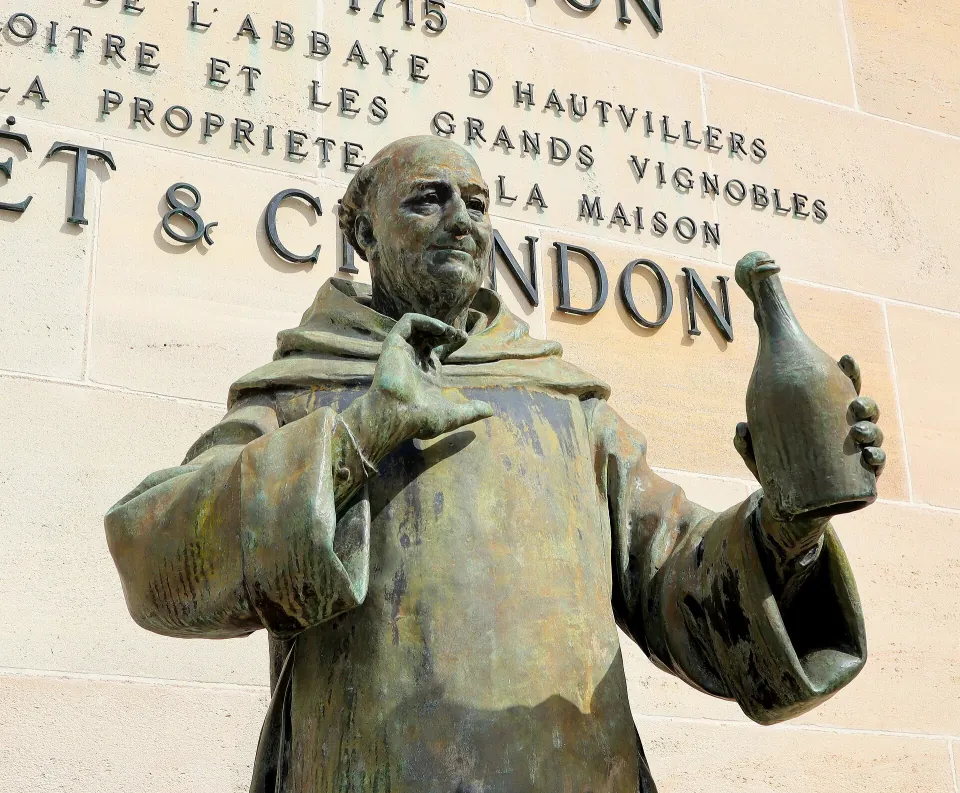
Pierre Pérignon was nineteen when he entered the monastery and thirty when his order sent him, in 1668, to the abbey of Hautvillers above Épernay to put the finances in order as cellarer. The abbey lived on the tithe, and a good part of the tithe arrived as grapes and wine. For almost fifty years, until his death in 1715, the monk looked after vineyards, press and cellar. The wine he made was still: a pale, fine wine from black grapes, meant to hold its own against burgundy at the court of Versailles.
A legend, a century later
The legend that he invented champagne arose a good century later. A successor at the monastery, Dom Groussard, told it in letters around 1820, and it was too good not to be repeated. The famous “Come quickly, I am tasting the stars” is younger still: it comes from nineteenth-century advertising. Historically, the opposite is more likely. In Pérignon’s day a second fermentation in the bottle was an accident that burst bottles, and the cellarer did what he could to avoid it.
To drop at the apéro
“Come quickly, I am tasting the stars” is not Dom Pérignon’s line but nineteenth-century advertising: the monk was trying to get rid of the bubbles.
What he really could do
What he really could do was impressive enough. Pérignon blended the grapes of different villages and plots into one cuvée instead of making each parcel on its own, and tasted the grapes on the vine before the harvest to decide. He pressed the black grapes quickly and gently so that the juice came out almost white, had the vines pruned short and the grapes picked early in the morning while they were still cool. Every one of these principles is part of the craft in Champagne today.
The brand and the monk
The cuvée that carries his name has nothing to do with the monastery. The “Dom Pérignon” brand belonged to the house of Mercier, which handed it to Moët & Chandon in 1927. Moët bottled the 1921 vintage as a prestige cuvée and launched it in 1936, at the request of its London importers, who wanted something special for an anniversary. Since then Dom Pérignon has existed only in the years the house judges good enough, from Chardonnay and Pinot Noir, with long years on the lees. Whoever looks at the statue of the monk outside the house in Épernay today is looking at a brand that turned an honest craftsman into an inventor. Both are worth knowing before the cork comes out.