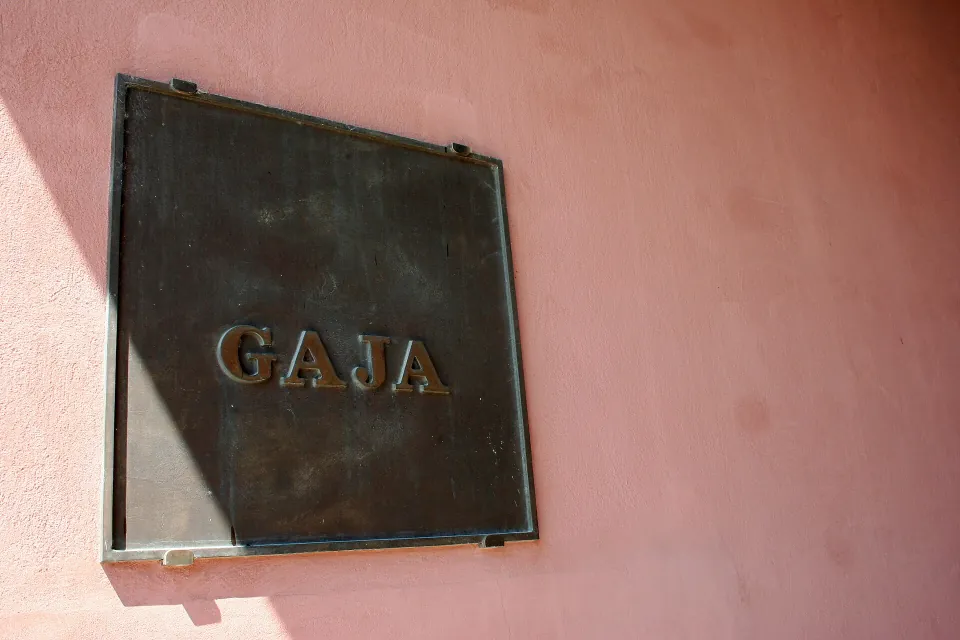
In the 1960s Barbaresco was a village of a thousand people and a wine that lived in the shadow of Barolo, mostly sold anonymously to merchants. Angelo Gaja, born here in 1940, had studied oenology in Alba and economics in Turin and joined the firm his great-grandfather Giovanni had founded in 1859 in 1961. His father, another Giovanni, had already done the right thing: bought his own vineyards and made wine only from his own grapes. Angelo did the unheard of. He cut yields drastically, dropped green bunches in summer so the rest would ripen better, and in 1967 bottled Sorì San Lorenzo, the first Barbaresco from a single vineyard. Sorì Tildìn followed in 1970, Costa Russi in 1978.
Barrique and Darmagi
From France he brought the barrique, the small oak cask that Piedmont regarded as a betrayal of the big old botti, and in 1978 he planted Cabernet Sauvignon on a plot in front of the house where Nebbiolo had stood. His father is said to have looked at the young vines and said one word, “darmagi”, Piedmontese for “what a pity”. Angelo gave the wine, first released in 1982, exactly that name. The prices he asked soon matched those of the great Bordeaux, and he defended them with an argument then foreign to Italy: whoever wants the best must pay for the best.
To drop at the apéro
When Angelo Gaja planted Cabernet Sauvignon in Barbaresco in 1978, his father sighed “darmagi”, Piedmontese for “what a pity”. Angelo named the wine after it.
The quarrel of 1996
The biggest quarrel came in 1996. Gaja took his three single vineyards out of the Barbaresco DOCG and bottled them as Langhe Nebbiolo DOC, because he wanted to add a small share of Barbera, which the Barbaresco rules forbade. It was also a statement: the name Gaja should count for more than the appellation. It stayed that way for seventeen vintages. With the 2013 vintage Sorì San Lorenzo, Sorì Tildìn and Costa Russi returned to the Barbaresco DOCG as pure Nebbiolo, a step encouraged by his daughter Gaia, who runs the house today with her siblings Rossana and Giovanni.
Across the Apennines
In the 1990s Gaja expanded into Tuscany: in 1994 he bought Pieve Santa Restituta in Montalcino for Brunello, and in 1996 he founded Ca’ Marcanda in Bolgheri, home of the Bordeaux grapes. What remains is more than a brand. Gaja forced Piedmont to think about vineyards, yields and prices, and paved the way for the Barolo Boys and the renaissance of Nebbiolo. Anyone who orders a single-vineyard Barbaresco in a Zürich restaurant today without raising an eyebrow owes him something.