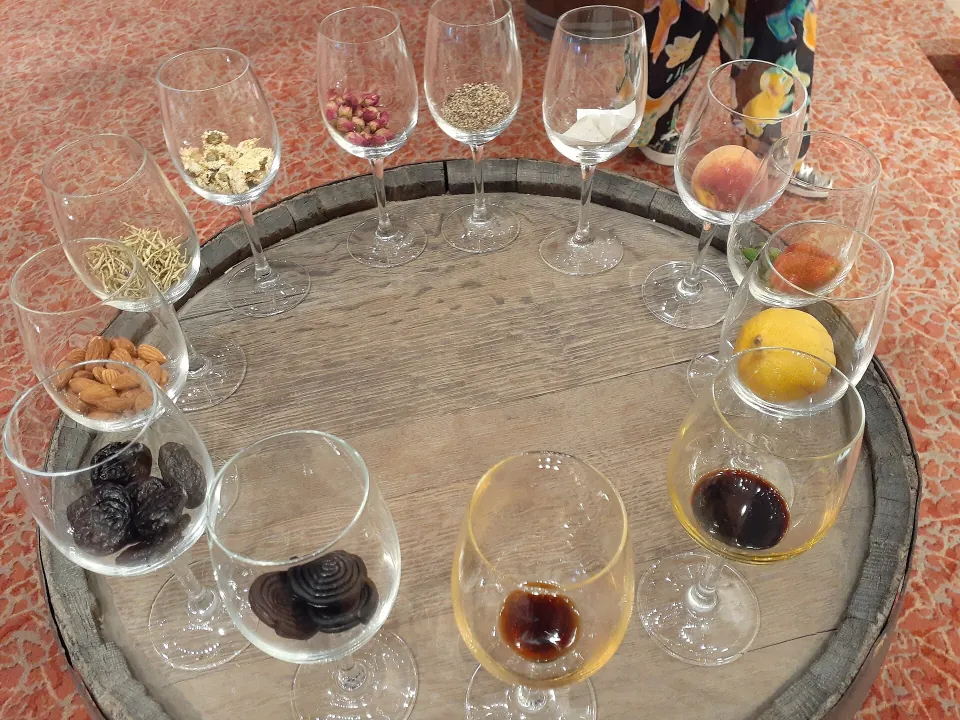
An aroma kit is expensive; a kitchen you already have. For an aroma game you need a dozen identical glasses, saucers to cover them, a bottle each of plain, neutral white and red wine, and whatever is in the larder: pepper, cloves, vanilla, lemons, berries, a green pepper, a bag of lime-blossom tea. Each glass gets a little wine and one ingredient, about an hour before the game, covered so the scent stays in the glass. The glasses are numbered, and the answers go on a slip of paper. The idea is not new: the sensory scientist Ann C. Noble suggested reference standards like these for her aroma wheel, and wine schools still use them today.
Four games for one evening
Several games can be made of it. In blind sniffing each glass goes round the table, and whoever names the scent first scores a point. In aroma memory each scent stands twice in opaque cups, and you hunt for the pairs with your nose. In matching, real wines stand next to the glasses: which ingredient is hiding in the Sauvignon Blanc, which in the Syrah? And in aroma bingo everyone has a card of scents and ticks off what they find in the wine. The third game is the best for tasting, because it takes the scents back where they belong: into a glass of real wine.
To drop at the apéro
Roughly one person in five cannot smell the pepper in Syrah: in a 2008 Australian study about 20 per cent of tasters could not detect rotundone even at high concentration.
No two noses alike
Not everyone smells the same thing. In a 2008 Australian study that identified rotundone as the pepper scent of Syrah, about 20 per cent of the tasters could not detect the compound even at high concentration. Such gaps are called specific anosmia, and they explain many an argument at the table. Conversely, the sense of smell can be trained: in the smell training that the Dresden researcher Thomas Hummel described in 2009, you sniff four scents twice a day, rose, lemon, clove and eucalyptus. Today it is recommended to people who have lost their sense of smell, after a viral infection for instance. For the aroma game that means there are no wrong noses, only untrained ones.
The kitchen aroma bar
Twelve glasses for one evening: what goes in, and which grape it portrays.
- in white wine: slices of apple and pear, a bag of lime-blossom teaChasselas
- in white wine: grapefruit peel, a piece of rhubarbPetite Arvine
- in white wine: a dash of elderflower cordial, freshly cut grassSauvignon Blanc
- in white wine: lemon and lime zest, a slice of green appleRiesling
- in white wine: tinned lychees, a rose petalGewürztraminer
- in white wine: a knob of butter, a scraped vanilla podChardonnay
- in red wine: crushed strawberries and raspberriesGamayPinot Noir
- in red wine: black cherries, a cloveCornalin
- in red wine: a spoonful of blackcurrant jam, a strip of green pepperCabernet Sauvignon
- in red wine: freshly crushed black pepperSyrah
- in red wine: a cut button mushroomPinot Noir
- in white wine: a piece of wet cardboardCork taint
- in white wine
- in red wine
A little wine and one ingredient per glass, about an hour ahead, covered. The dot shows the base wine.
The Swiss round
For a Swiss round, a separate pass with home-grown grapes is worthwhile. Apple, pear and a bag of lime-blossom tea make the picture of Chasselas, grapefruit peel and a piece of rhubarb that of Petite Arvine, black cherries and a clove that of Cornalin. Add a glass of the real wine each time, and the game becomes a small tasting through Vaud and Valais. To get to know faults, put a piece of wet cardboard in a glass: a corked wine has much the same musty smell. At the end you may drink, but from freshly poured glasses, not the ones with the ingredients.