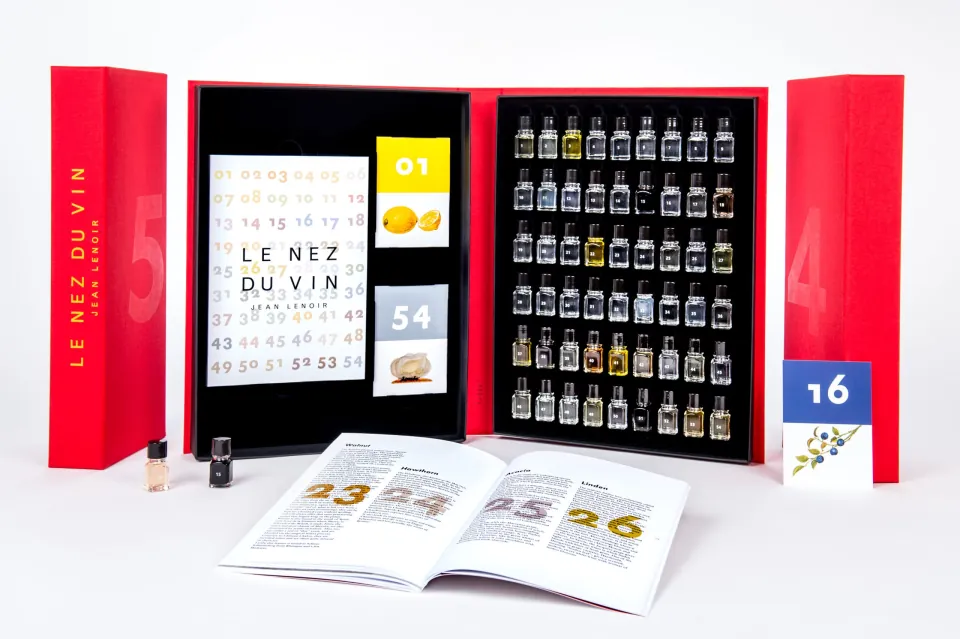
You open a vial, sniff and guess: raspberry or strawberry, violet or rose? Then you turn the card over. “Le Nez du Vin”, the nose of wine, is a case of 54 small glass vials, each holding a scent found in wine, with numbered cards and a book. Since 1981 it has been the training tool of everyone who wants to learn to smell: wine lovers, trainee sommeliers, candidates for the wine diplomas. It is a game and a teaching aid at once, and that was exactly what its inventor intended.
A book you smell
Jean Lenoir, born in Burgundy in 1937, a farmer’s son, ran youth and arts centres in Dole, Besançon and Chalon-sur-Saône, and trained as an oenologist in Beaune at around 40. For his courses he gathered 120 scent vials in a briefcase, with raw materials from suppliers in Grasse, the perfume town. He owed the form to art: the Swiss Eat Art artist Daniel Spoerri exhibited at the Chalon centre, and his book objects gave Lenoir the idea of publishing smells like a book. The first edition appeared in 1981, secured by about a thousand advance orders from his circle; in 1982 he founded his publishing house, a family business. Lenoir died in 2023.
To drop at the apéro
The kit owes its form to art: Jean Lenoir worked at an arts centre in Chalon-sur-Saône, where the Swiss Eat Art artist Daniel Spoerri exhibited and gave him the idea of a book you smell.
Five families, 54 scents
The large case sorts the scents into five families: fruity, floral, vegetal and spicy, animal, toasted. The first edition also held wine faults; today they have a case of their own with twelve vials, as do the twelve aromas of the oak barrel. Behind many a scent stands a single molecule that is also found in wine: rotundone smells of black pepper and marks Syrah, methoxypyrazines recall green pepper and lurk in Cabernet Sauvignon and Sauvignon Blanc, TDN gives aged Riesling its petrol note. Aroma chemistry has one of its centres in Geneva, where Givaudan and Firmenich grew into global groups. And at Agroscope, analyses of Chasselas from Dézaley showed that isoamyl acetate, with its scent of banana, marks young vintages, and furfural, with its bready note, older ones.
The molecule behind the scent
Many scents in an aroma kit go back to a single substance that is also found in wine.
- Black pepperrotundoneSyrahespecially from cool sites
- Green peppermethoxypyrazines (IBMP)Cabernet SauvignonSauvignon BlancCarmenèreabove all in underripe grapes
- Passion fruit, grapefruit, blackcurrant budthiols (3MH, 4MMP)Sauvignon Blancfrom Marlborough, for one
- PetrolTDNRieslingwith age, stronger from sunny sites
- Lychee, rosecis-rose oxide, geraniolGewürztraminerMuscatfrom the grape itself
- Bananaisoamyl acetateChasselasBeaujolaisin young wines, such as young Chasselas from Dézaley
- BreadfurfuralChasselasaged Chasselas from Dézaley; toasted barrels too
- ButterdiacetylChardonnayafter malolactic conversion
- Vanillavanillinfrom the oak barrel
- Coconutwhisky lactoneRiojafrom American oak
- Wet cardboard, damp cellarFaultTCA (trichloroanisole)cork taint: a few billionths of a gram per litre will do
- Stable, sticking plasterFault4-ethylphenolthe yeast Brettanomyces, often in barrel
A scent in wine is seldom a single substance, but these molecules mark it. Rotundone: Wood and others, 2008; Chasselas: Agroscope, 2026.
Training as for the exam
The kit does not replace the glass, but it sharpens the memory. Short sessions work best: three or four vials a day, first looking at the card, then blind, then in the wine itself. Anyone who has once smelled the pepper note on its own will find it again in a Syrah from Valais or the Rhône. Because the large case is expensive, wine clubs and tasting groups often buy one together; part of the training also works with your own kitchen, as the home-made aroma games show. Lenoir later carried the idea over to coffee and whisky, with cases of their own.