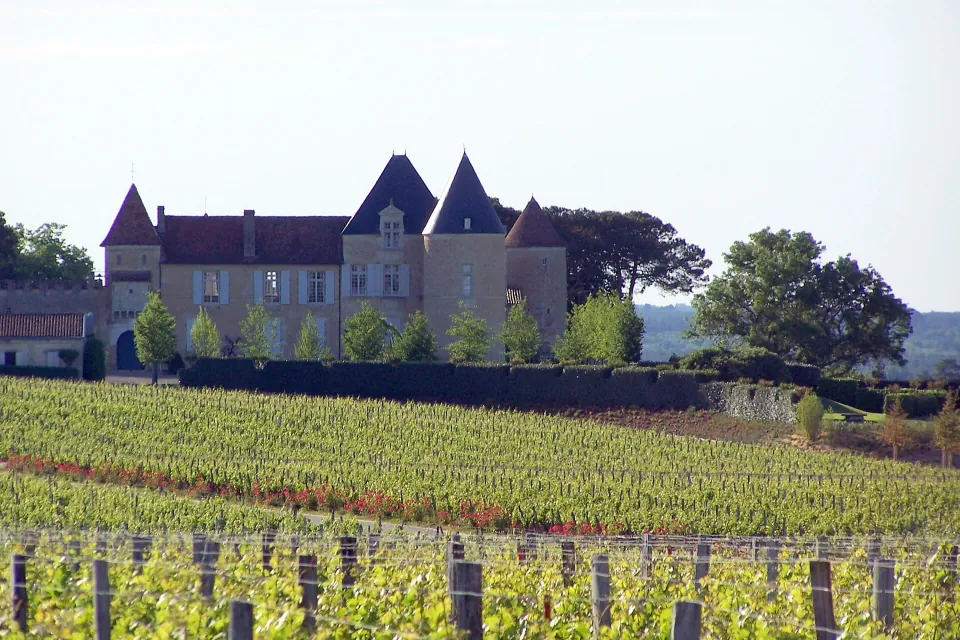
When the Bordeaux brokers wrote their classification in 1855, they put the sweet wines of Sauternes and Barsac on a list of their own. At the very top, alone in a class that exists for no other wine, stood Château d’Yquem: Premier Cru Supérieur. Thomas Jefferson had already visited the estate in 1787 and ordered bottles of the 1784 vintage for himself and for George Washington. Yquem was then already what it is today: the benchmark for sweet wine.
A miracle of a fungus
The miracle behind it is a fungus. In autumn the cool little river Ciron sends mists over the vineyards that the midday sun burns off. Damp in the morning, warm in the afternoon: ideal conditions for Botrytis cinerea, noble rot, which punctures the skins and shrivels the grapes into raisins. Sugar, acidity and aromas concentrate, and out comes the scent of apricot, honey and saffron that defines Sauternes. Because the fungus does not strike every berry at once, the pickers go through the same rows several times, in “tries”, picking only the berries that are ready. It can take six weeks.
To drop at the apéro
One vine at Yquem yields on average a single glass of wine, and in poor years such as 1992 or 2012 the estate released no Yquem at all.
The numbers follow: around 100 hectares, three quarters Sémillon and a quarter Sauvignon Blanc, and yields of about nine hectolitres per hectare, a fraction of what an ordinary vineyard gives. Per vine, on average, one glass of wine is left. And if the autumn does not play along, there is none at all: in 1910, 1915, 1930, 1951, 1952, 1964, 1972, 1974, 1992 and 2012 no Yquem was bottled. Those refusals are part of the myth.
Two centuries of Lur-Saluces
From 1785 to 1999 the estate belonged to the Lur-Saluces family, lastly to Comte Alexandre de Lur-Saluces, who lost it to the luxury group LVMH after a bitter family feud. Since 2004 Pierre Lurton, who also heads Cheval Blanc, has run the house. In 2011 a sommelier bought a bottle of the comet vintage 1811 for 75,000 pounds, still the highest price ever paid for a bottle of white wine. Since 1959 there has also been the dry “Y”, pronounced Ygrec, for years and grapes without noble rot.
Young opulent, old immortal
For the glass: a young Yquem is opulent, an old one turns nutty and almost immortal; once opened, the bottle keeps for weeks in the fridge. To discover noble rot without this pageantry, try a Sauternes from a neighbour or, closer to home, a Valais Flétri from Petite Arvine or Ermitage, which works with the same tools: late picking, shrivelled berries, patience.