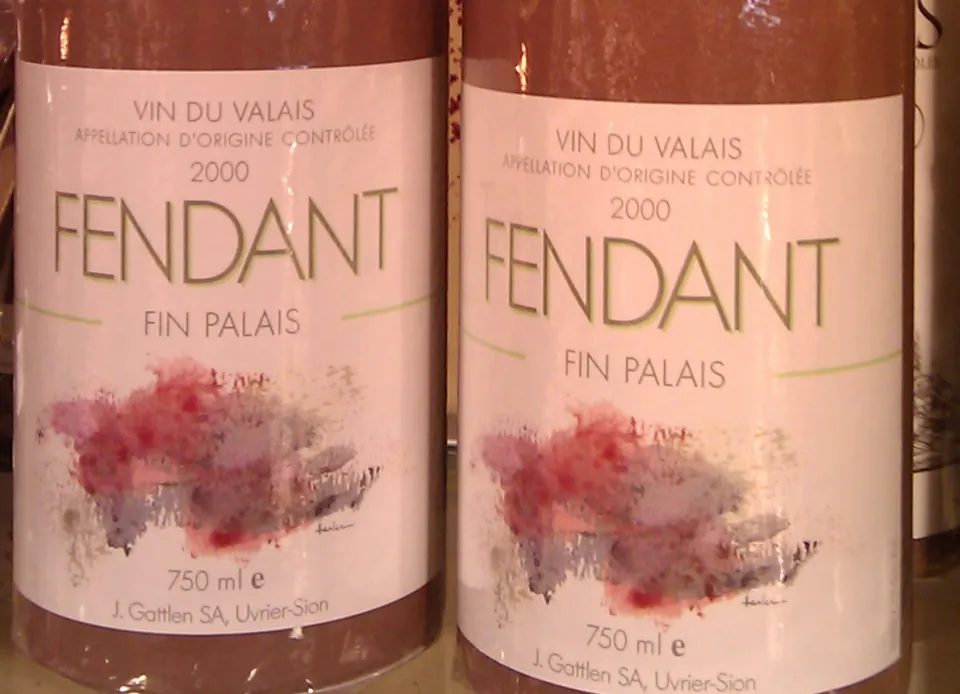
Two bottles stand on the shelf: «Fendant, Vin du Valais, Appellation d’origine contrôlée, 2000» beside «Schweizer Tafelwein», Swiss table wine, with no year and no grape. That silence is the rule, not an oversight. A Swiss wine label is a small form, governed by three federal ordinances and the cantons’ regulations. Know them, and you read the bottle in a minute, promises and silences included.
The backbone is the class. The Confederation knows three, AOC, Landwein and table wine; the rules of an AOC are written by the canton it lies in. Hence AOC Valais or AOC Zürich, and DOC in Ticino (wine ordinance, SR 916.140, Art. 21).
To drop at the apéro
On a «Schweizer Tafelwein», Swiss table wine, grape and vintage are not missing out of modesty: federal law forbids both statements on that class (wine ordinance, Art. 27e).
What every bottle must carry is listed, essentially, in the FDHA ordinance on beverages (SR 817.022.12, Art. 75): class and origin, name and address of whoever answers for the wine, country of production, alcohol in % vol, volume, lot and sulphites, all in one field of vision except lot and sulphites. Grape and vintage stay optional; ingredients and calories a label owes nobody.
What the label says
Eight statements, from the wine’s class to the sulfite notice: what is compulsory and what only AOC and Landwein may carry.
- Denomination and class compulsory
AOC (controlled designation of origin), Landwein or table wine. The rules of an AOC are set by the canton, hence AOC Valais or AOC Zürich; DOC in Ticino.
- Vintage optional
At least 85 per cent of the wine comes from the year named. Optional, and forbidden on table wine.
- Grape variety optional
The varieties named make up at least 85 per cent between them; several are listed in descending order. Optional, and forbidden on table wine.
- Name and address compulsory
Producer, bottler, merchant or importer: whoever answers for the wine.
- Country of production compulsory
Swiss wine contains no foreign wine; an AOC wine may be blended with up to 10 per cent Swiss wine of the same colour.
- Alcohol compulsory
In per cent by volume.
- Volume and lot compulsory
What is in the bottle, and the lot number that traces a bottling.
- “contains sulfites” compulsory
Compulsory from 10 mg/l of sulfur dioxide, which means almost every bottle.
The label, line by line
- Class and origin Look for AOC or DOC, Landwein or table wine. On an AOC the origin follows, a canton or an area within it such as Dézaley; on a Landwein, a provenance larger than a canton.
- Cru and other terms Grand Cru, Premier Grand Cru, Premier Cru and VITI are cantonal steps within the AOC; Réserve, Spätlese or Flétri are protected nationwide (wine ordinance, Annex 1).
- Grape and vintage Named varieties make up at least 85 % between them, in descending order: in «Gamaret-Garanoir» Gamaret prevails. At least 85 % comes from the year named. Both optional, both forbidden on table wine.
- Who answers for it A name and an address are compulsory: producer, bottler, merchant or importer. «Mis en bouteille au domaine» or «Gutsabfüllung» promises more: the producer’s own wine, bottled on the estate; a merchant may not write it.
- Alcohol and volume Alcohol is stated in % vol, to within 0.5 % vol, 0.8 for sparkling wine (food information ordinance, SR 817.022.16, Art. 18). The volume reads in centilitres; 75, 70 and 50 cl are the usual sizes.
- Lot and sulphites The lot, usually an «L» and digits, makes a bottling traceable (food information ordinance, Art. 20). «Contains sulphites» is compulsory from 10 mg of sulphur dioxide per litre, which means almost always (Annex 6).
- Sweetness dry up to 4 g/l of residual sugar, medium dry 4 to 12, medium sweet 12 to 45, sweet beyond; optional on a still wine, compulsory on a sparkling one, on a scale of its own. In Valais, sweet wine from shrivelled grapes is called «Flétri», and Amigne de Vétroz counts its sweetness in bees, one to three.
What the cantons add on top
In Valais, Grand Cru is decided in the commune, by a regulation of its own and for a few indigenous varieties. Vaud asks of its Grand Cru at least 90 % of grapes from the commune named; since 2009 the Premier Grand Cru has crowned the pyramid. Geneva calls its strictest step Premier Cru; Ticino awards the VITI seal to Merlots that pass a tasting. Then the named wines: Dôle is a Valais AOC red from Pinot Noir and Gamay, Pinot Noir leading, at least 51 % of the two instead of 85 since the 2021 vintage, the rest from other red Valais varieties; Goron is the Valais Landwein below it, Salvagnin the Vaud counterpart of Dôle.
What to trust
Trust the compulsory part: class, origin, address and lot are checked, and a Swiss wine holds no foreign wine; an AOC may be cut only with up to 10 % Swiss wine of the same colour, a Landwein with 15 (wine ordinance, Art. 27d). The rest is decoration: no law limits the medal stickers on a bottle, and gold says only that a jury liked the wine on one day. Read the small print first, and only then the name in big letters.