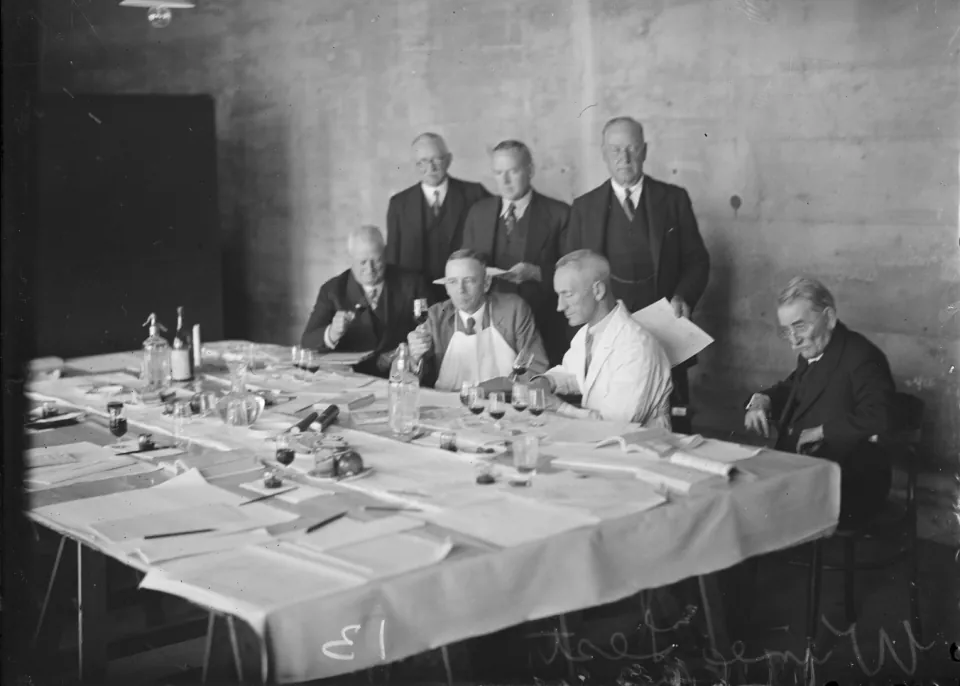
In 1826 the Agricultural Society of New South Wales offered a small gold medal for the best colonial wine: at least ten gallons, certified on oath to be pure grape juice of that vintage. Sydney still judges wine two hundred years later, and until 1961 its show paid prize money too; then it settled on gold, silver and bronze. Today the money flows the other way. In a wine competition the contestants pay: a fee for every wine, three bottles of it and, if it wins, the stickers. Nobody has counted how many competitions there are. In 2015 the OIV, the intergovernmental organisation of wine, put those carrying its patronage at about thirty a year.
London judges more wines than anywhere else
26 competitions and the wines of their latest edition, by the city they judge in: 90,049 wines in all.
The world
Europe, enlarged
- in Switzerland
- elsewhere
- Area: number of wines
Sources: the organisers, latest edition (2025 or 2026); Mundus Vini (spring tasting) and the IWSC as the trade press reported them, Decanter from its published shares. The Concours Mondial de Bruxelles judges in a different city every year. The International Wine Challenge and the Berliner Wein Trophy publish no total.
London, Paris, Sierre
The map of the big competitions is mostly a map of Europe, and London is its capital. At the Decanter World Wine Awards, run by the magazine of that name, 245 judges tasted almost 17,000 wines from 58 countries in 2026, more than at any other competition; the International Wine & Spirit Competition and the International Wine Challenge judge in London too. Paris holds the Concours Général Agricole for French wines, and the Concours Mondial de Bruxelles travels: to Yinchuan in China in 2025, to Yerevan in 2026. Switzerland’s centre is Sierre. There the association Vinea judges the Mondial des Pinots, the Mondial du Merlot and, with the magazine Vinum, the Grand Prix du Vin Suisse: 2,844 Swiss wines in 2026. Overseas, the agricultural shows of Sydney and Melbourne judge only Australian wine.
To drop at the apéro
In a wine competition the contestants pay for the prize: 140 to 200 francs a wine, the stickers extra. At Decanter in 2026, five wines in six went home with a medal.
Who sits at the table
Who enters? Mostly estates and cooperatives that want their bottle to stand out on the shelf: to the Concours Mondial in 2026, France sent 1,183 wines, Italy 1,098 and Portugal 789. Who judges? Winemakers, oenologists, sommeliers, merchants and writers. The OIV’s guidelines, revised in 2025, describe a fair jury: at least five tasters, seven recommended, no more than half of them from the host country, at least one oenologist, at most 45 wines a day, every bottle wrapped. Under its patronage at most 30 per cent of the wines entered may win a medal, gold from 89 points out of 100 and grand gold from 93; French law allows a third.
Seven chairs, 45 glasses: a jury under the OIV’s rules
The guidelines of 2025: at least five judges, seven recommended, no more than half from the host country, at least one oenologist. Each tastes at most 45 wines a day, in three sessions of about 15, blind and in silence.
One judge’s day
- from the host country, at most half
- from other countries
- oenologist
- Decanter 2026: 245 judges from 35 countries, 63 of them Masters of Wine
- Concours Mondial de Bruxelles 2025: 375 judges from 56 countries
- Mondial du Chasselas 2026: 86 judges, 38 from abroad
- Sakura 2026: 430 judges, all of them women
Sources: OIV, guidelines for international competitions (OIV-OENO 671A-2025); the organisers.
What a medal costs
One wine costs 140 francs to enter at the Grand Prix du Vin Suisse, 170 at the Mondial des Pinots, 205 euros at the Concours Mondial and 172 pounds at Decanter, plus VAT where it applies: almost 2.9 million pounds in fees at Decanter alone. Stickers come on top, a few cents apiece: AWC Vienna asks 25 euros for a roll of 1,000, and the New Zealand International Wine Show charges every gold medallist 250 New Zealand dollars. None of them pays prize money. What a medal is worth depends on how many there are. At Decanter, 14,168 wines won one in 2026, about five in six. Where a cap applies, a medal costs the entrants 270 to 630 francs in fees; at Decanter, 222.
At Decanter 85 per cent of the wines win a medal; under the OIV’s rule, at most 30 per cent
The share of the wines entered that won a medal at the latest edition.
- capped: at 30 per cent (OIV, Swiss oenologists) or a third (France)
- no cap
- 30 per cent
- in Switzerland
Sources: the organisers; medals of every level divided by the wines the organiser gives as entered. Merit labels and certificates below the medals are not counted. Veritas counts its brandies.
The rarer the medal, the dearer it is
What entering one wine costs (dot) and what the entrants pay in fees for every medal awarded (ring), in francs without VAT.
Fee and price per medal
Fee only: no medal count published
- fee for one wine
- fees per medal
- capped: at 30 per cent (OIV, Swiss oenologists) or a third (France)
- no cap
Sources: the organisers’ entry forms for one wine, converted at the SNB’s monthly averages for September 2026. Per medal: the fee divided by the share of wines that won one. Shipping, bottles and stickers not included. Melbourne: fee 2026, medals 2025; San Francisco and Sakura: fee for 2027.
Luck, price and the sticker
Do medals mean anything? In 2009 the statistician Robert Hodgson followed 2,440 wines entered in more than three American competitions: 47 per cent won gold somewhere, and 84 per cent of those won nothing at another. In 2017 Christopher Bitter found that gold medallists scored no higher in two leading magazines than other medal winners. Yet medals sell. Shoppers who take little interest in wine lean on them more than enthusiasts do, Larry Lockshin and his colleagues showed in 2006, and in Bordeaux Emmanuel Paroissien and Michael Visser measured in 2020 that a producer can ask traders 13 per cent more after a medal. They also found which medals track quality: those of old competitions whose judges taste few wines a day. So read a sticker like a label: who gave it, in which year, and to how many others.