On 28 March 2026, at Acker’s La Paulée auction in New York, a single bottle of 1945 Romanée-Conti sold for 812,500 dollars. It was no stranger to the saleroom: according to Wine Spectator, the same bottle from the cellar of Robert Drouhin had fetched 558,000 dollars at Sotheby’s in 2018, against an estimate of at most 32,000. At six glasses to the bottle, that is about 135,000 dollars a glass. What makes a wine that expensive? Not the grape, and not the cellar work alone, but scarcity, age, a name and a market that bids for all three.
Pinot Noir from a few hectares
In Wine-Searcher’s 2026 ranking of average prices, nine of the ten most expensive wines are from Burgundy: six Pinot Noirs from grands crus of the Côte de Nuits, three Chardonnays from Montrachet and its neighbours. The tenth is a Riesling, Egon Müller’s Trockenbeerenauslese from the Saar, picked berry by berry. Burgundy’s secret is size. Since Napoleon’s civil code, inheritance has split the vineyards among all the children, a grand cru often has many owners, and Romanée-Conti gives about 5,000 to 6,000 bottles a year from 1.8 hectares, for the whole world. The Musigny at the top of the list is made by Lalou Bize-Leroy’s Domaine Leroy from a fraction of a hectare.
To drop at the apéro
A glass of the world’s dearest wine, Leroy’s Musigny, costs about 10,000 dollars on average; the 1945 Romanée-Conti sold in March 2026 came to about 135,000 dollars a glass.
What a bottle costs today
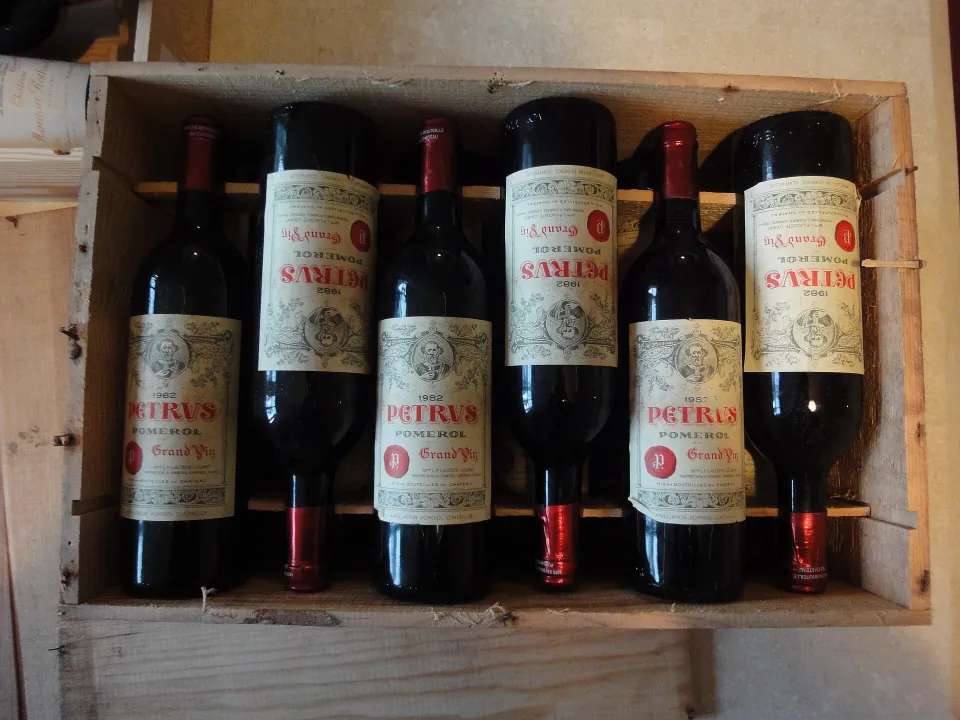
The price behind the ranking is the average of what merchants worldwide ask, across all the vintages on offer and without tax. In 2026 Leroy’s Musigny led at 61,596 dollars, followed by two whites from Domaine d’Auvenay, Lalou Bize-Leroy’s own estate, and Romanée-Conti at 24,005 dollars. The great names of Bordeaux and the New World look almost modest beside them: Pétrus about 4,300 dollars, Screaming Eagle from the Napa Valley about 3,700, Château Lafite about 900, Penfolds Grange and Yquem a few hundred. None of these is the estate’s price: it is what the wine fetches once it has left the cellar.
Where the ten dearest come from
Wine-Searcher’s 2026 ranking, by origin and by grape.
- 9 / 10from BurgundyThe rest: Mosel (1)
- 6 / 10Pinot Noirall from grands crus of the Côte de Nuits
- 0 / 10from Bordeaux, Champagne or the New WorldPétrus comes to about 4,300 dollars, a fourteenth of the leader.
The ten by rank, coloured by wine
What a bottle costs today
Average price of a 75 cl bottle across the vintages on offer, without tax, in US dollars. The ten dearest by Wine-Searcher’s ranking of 30 September 2026, then famous names on the same scale.
The ten dearest of 2026
Famous names for comparison
- Red wine
- White wine
A glass is a sixth of the bottle (12.5 cl). The comparison prices come from Wine-Searcher rankings from December 2025 to October 2026 and are rounded. Prices move with the vintage, the supply and the exchange rate.
Records under the hammer
Auctions write the other half of the story. In 1985 Christie’s in London sold a bottle of Lafite 1787 engraved with Thomas Jefferson’s initials for 105,000 pounds; it came from the collector Hardy Rodenstock, and its authenticity has been doubted ever since, as the page on “Sour Grapes” tells. In 2010, as Hong Kong became the hub of the trade, three bottles of Lafite 1869 went for about 230,000 dollars each, and in 2011 a bottle of Yquem 1811 changed hands privately for 75,000 pounds, still the dearest white. Large bottles fetch large sums, such as 310,700 dollars for a 4.5-litre Mouton 1945 in 2007, and Australia’s record is a Grange 1951 at 157,624 Australian dollars in 2021. Since 2018 the record for a standard bottle has belonged to Burgundy.
Records under the hammer
The highest prices ever paid for a bottle, by year of sale. Prices with the buyer’s premium, as reported; the bar in dollars of the day.
- Red wine
- White wine
Large bottles are marked: 6 litres are eight standard bottles, 4.5 litres six. According to Wine Spectator, the 1945 Romanée-Conti of 2018 and of 2026 is the same bottle.
Buy it, taste it
Buying most of them takes a long history with a merchant: Romanée-Conti is sold by allocation only, Screaming Eagle through a mailing list with a waiting list of years, Egon Müller’s Trockenbeerenauslese only at the VDP auction in Trier, where private buyers bid through a commission agent. Pétrus, Lafite and Yquem reach the market through the négociants of Bordeaux, and Penfolds released Grange 2022 in August 2026 at 1,000 Australian dollars, into ordinary wine shops. Tasting is harder still: Romanée-Conti, Pétrus and Screaming Eagle do not receive the public, and Lafite is closed for building work until 2028; Yquem, by contrast, can be visited by reservation, and Penfolds pours Grange by the glass at the restaurant of its old Magill Estate near Adelaide. In Switzerland the auctions in Geneva and Zürich are open to anyone who registers. And the cheapest way into the style is next door: a village wine from Vosne-Romanée, or a Pinot Noir from the Bündner Herrschaft.
Can you buy it? Can you taste it?
How these wines are sold and whether the estate receives visitors, as of October 2026.
-
Romanée-Conti Grand CruBurgundy
about 5,000–6,000 bottles a year
- Buy
- allocation only, through a single importer per country
- Taste
- no visits. no visits for the public
-
Scharzhofberger Riesling TrockenbeerenausleseMosel
often only a few dozen bottles, not every year
- Buy
- only at the VDP auction in Trier, bidding through a commission agent
- Taste
- the trade or the invited only. at the tasting before the auction, meant for the trade
-
about 30,000 bottles a year
- Buy
- en primeur through the Bordeaux négociants
- Taste
- no visits. no visits, by personal invitation only
-
Screaming Eagle Cabernet SauvignonNapa Valley
about 5,000–10,000 bottles a year
- Buy
- through the mailing list; the wait lasts years
- Taste
- no visits. no tasting room, no visits
-
Château Lafite RothschildBordeaux
about 180,000–240,000 bottles a year
- Buy
- en primeur through the Bordeaux négociants
- Taste
- no visits. closed to visitors until January 2028 for building work
-
quantity not published
- Buy
- in wine shops every year; the 2022 came out in August 2026 at 1,000 Australian dollars
- Taste
- anyone can book a visit. a glass of Grange at the restaurant of the old Magill Estate near Adelaide
-
about 60,000–100,000 bottles a year
- Buy
- bottled, every March, through the Bordeaux négociants
- Taste
- anyone can book a visit. visits by reservation
- anyone can book a visit
- the trade or the invited only
- no visits
All of them also change hands at auction and between merchants, at the market price. A glass of Grange is one of the few in this league that anyone can order.