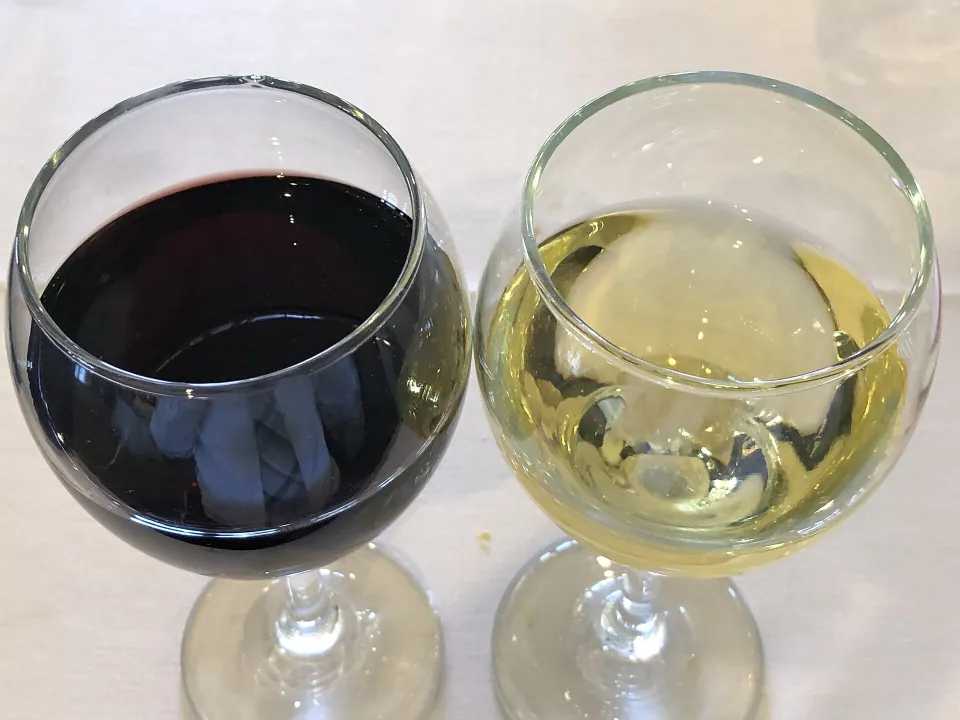
In 2001 the oenologist Frédéric Brochet had 54 students at the faculty of oenology in Bordeaux describe a white and a red Bordeaux. A week later they met the white again, beside the same white dyed red with a grape pigment that neither smells nor tastes, and had to say which glass showed each of their words more. Their red-wine words they mostly gave to the dyed white. The test became a classic proof that we drink with our eyes. So is a good wine all in the head, or can a laboratory prove it?
What the laboratory can prove
A laboratory can prove a great deal. It measures cork taint, the molecule TCA, in nanograms per litre: tasters notice it from about 2 and reject the wine from about 3 (John Prescott, 2005). It unmasks forgeries without pulling the cork: Philippe Hubert’s team in Bordeaux measures caesium-137 through the glass, an isotope the nuclear tests first spread in the 1950s, so a genuine older wine has none (2009). The one word it cannot print on any report is “good”.
To drop at the apéro
In 1757 David Hume told of two tasters mocked for finding leather and iron in a hogshead, until it was emptied and an old key on a leather thong lay at the bottom.
In 2009 Paulo Cortez and colleagues at the University of Minho fed a computer eleven lab values of 6,497 Vinho Verdes and the score tasters had given each one blind; it then hit the exact score about two times in three. Impressive, though most wines scored 5 or 6 out of 10, and the model learnt not quality but the judgement of those tasters. Nor is chemistry perception: rotundone, the pepper in Syrah, can be measured to the nanogram, yet about one taster in five could not smell it at all (Claudia Wood, 2008).
Judges who contradict themselves
People are no steadier. The statistician Robert Hodgson had the California State Fair pour four wines three times each, from one bottle, into its judges’ flights: only about one judge in ten kept all three scores within one medal (2008). Across 13 competitions, gold medals fell about as chance would scatter them (2009). Told a wine cost 90 dollars rather than 10, people in Hilke Plassmann’s brain scanner liked it more, and the region where the brain registers pleasure responded more strongly (2008). At ETH Zürich, Michael Siegrist and Marie-Eve Cousin found that a critic’s score sways the rating only if heard before the first sip (2009).
The key in the barrel
So is it all in the head? Not quite. Experts do not have keener noses than novices, only a better memory for smells (Wendy Parr, 2002), and in black glasses both tell red from white by smell alone well above chance (Jordi Ballester, 2009). What training changes is the yardstick: when the compounds of red wines were measured, consumers ranked those with more oak aromas higher and experts lower; the laboratory explained both verdicts and settled neither (María-Pilar Sáenz-Navajas, 2015). David Hume had the answer in 1757: in “Of the Standard of Taste”, Sancho Panza’s two kinsmen, mocked for tasting leather and iron in a hogshead, are proved right by an old key on a leather thong at the bottom. Taste is not arbitrary, Hume concluded: its standard is the joint verdict of judges with good sense, a delicate palate, practice, comparison and no prejudice.
That is where science stands. The laboratory finds the key in the barrel: the fault, the forgery, the composition. Whether the wine is good remains a human verdict, worth something only blind, from several tasters, more than once. Swiss law agrees: for every AOC the cantons must provide a system of analysis and of organoleptic examination (wine ordinance, Art. 21), and Geneva has samples tasted blind by at least five people. For your own glass: pull a sock over two bottles at different prices, and trust the one you pick twice.