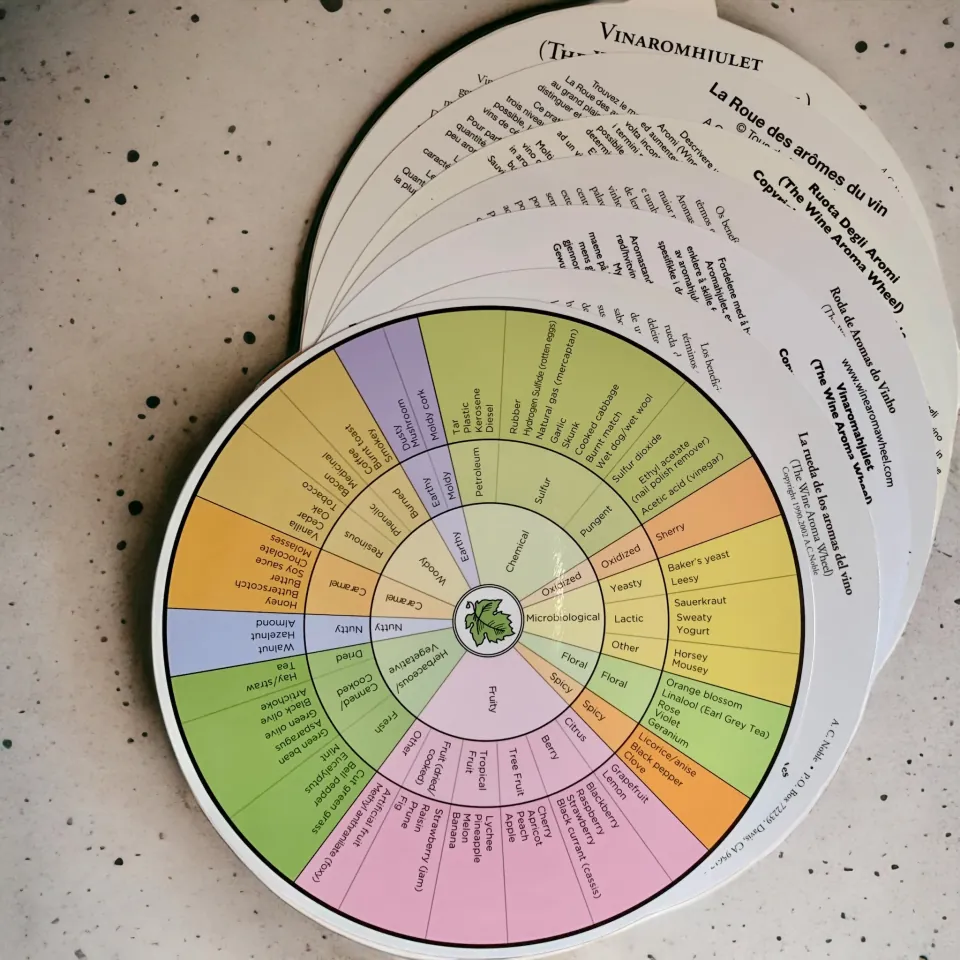
“Elegant”, “harmonious”, “expressive”: Ann C. Noble had no use for such words. The sensory scientist came to the University of California, Davis in 1974, the first woman on the faculty of its department of viticulture and enology, and for her experiments she needed a language that every taster would understand the same way. So she collected terms with students and professionals, struck out everything judgemental or vague, and arranged the rest on a circle. The wheel appeared in a scientific journal in 1984 and in a revised version in 1987, which still hangs in wine schools, wineries and tasting rooms today.
From the centre outwards
You read the wheel from the centre to the rim. The innermost ring holds twelve families: fruity, floral, spicy, vegetative, nutty, caramelised, woody, earthy, chemical, pungent, oxidised and microbiological. The middle ring divides them, fruity for instance into citrus, berry, tree fruit, tropical fruit and dried fruit, and the outer ring names the individual scents: grapefruit, blackberry, apricot, pineapple, raisin. If you smell something fruity in the glass but do not know what, you work your way outwards. The wheel does not hand you the answer; it asks the next question.
To drop at the apéro
Words like “elegant” or “harmonious” are missing from Ann Noble’s wheel on purpose: it lists only terms you can demonstrate with a sample in a glass.
A sample for every word
The heart of the method is not on the wheel but beside it. The 1987 version suggested reference standards for the terms that you can make up yourself, usually a neutral base wine with a small addition from the kitchen: a little pepper, a piece of green pepper, a drop of vanilla. A word thus becomes a smell that everyone in the room has smelled, and a tasting panel can agree. The principle caught on: schools such as the WSET work with fixed lists of terms, and aroma kits such as Le Nez du Vin deliver the samples ready-made in vials.
The twelve families of the wheel
The wheel’s inner ring, with one example in the glass for each. From here you work outwards.
- Fruityblackcurrant in Cabernet Sauvignon
- Floralrose in Gewürztraminer
- Spicyblack pepper in Syrah
- Vegetativecut grass in Sauvignon Blanc
- Nuttyhazelnut in barrel-aged Chardonnay
- Caramelisedhoney in Tokaji
- Woodyvanilla and cedar from the oak barrel
- Earthymushroom and undergrowth in aged Pinot Noir
- Chemicalpetrol in aged Riesling
- Pungentthe heat of alcohol in the nose
- Oxidisedthe note of oxidatively aged sherry
- Microbiologicalyeast and brioche in Champagne
The twelve families after Ann C. Noble and others (1987); the examples come from the grape and region articles.
The quarrel over petrol
The German version showed how touchy words can be. The Deutsches Weininstitut published separate wheels for white and red wine and removed the chemical family from the white wine wheel, and with it the petrol note, of all things one of the hallmarks of aged Riesling. Experts abroad criticised the move. For your own tasting the original is enough: lay it beside the glass, start in the centre and say only what you really smell. Describe a Chasselas this way and you land on apple and pear, among the tree fruits, and on lime blossom, among the flowers, and afterwards you have words for a wine that is often drunk in Switzerland but seldom described.