Someone always says it at the apéro: a bottle of wine costs less than a euro to make. For the wine in the cheapest bottles, it is true. In the week of 12 to 18 October 2026, Spain’s agriculture ministry quoted bulk white wine at 43.47 euros a hectolitre and red at 51.18: 33 and 38 cents for the 75 centilitres of a bottle. The grapes cost less still. White grapes in La Mancha fetched about 25 cents a kilo at the 2025 harvest, the farmers’ union Unión de Uniones reported. Under the rules of the La Mancha appellation, 100 kilos of grapes may give at most 74 litres of wine, so a bottle takes about a kilo. But a bottle is more than the wine in it.
Glass, cork and tax
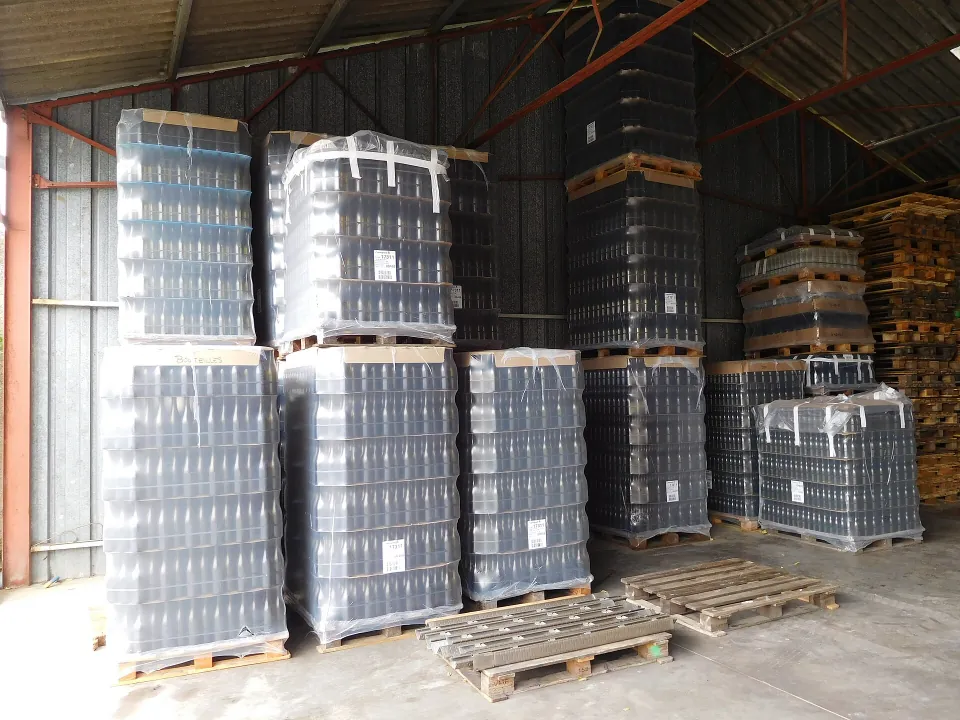
For the cheapest wine, the empty bottle alone costs almost as much as its contents: about 25 cents in Bordeaux and up to a euro in Champagne, the French consumer magazine Que Choisir reported in 2023. Then come cork, label, carton, transport, margins and tax. In Britain, the wholesaler Bibendum worked out in 2025 that of the 7.07 pounds an average bottle costs, only 62 pence go to making the wine. Switzerland levies no alcohol tax on wine, only VAT at 8.1 per cent, and much of the wine it imports travels without glass: in 2025 the Federal Office for Agriculture counted 49 of 130 million litres of imported red and white wine as bulk wine.
To drop at the apéro
In Bordeaux an empty wine bottle costs about 25 cents, Spanish bulk wine to fill it 33 to 38 cents: in the cheapest wine, the glass costs almost as much as what is in it.
The bill at the estate
At an estate that pays for every hour of work, the family’s included, the sums change. The Gironde chamber of agriculture calculated in 2024 that a plain AOC Bordeaux from a 40-hectare estate costs at least 3.33 euros a bottle to make, 3.94 if it is organic, and a Libournais or Haut-Médoc up to 6.14; even unbottled, in the tank, that Bordeaux costs 1.21 euros for 75 centilitres. For Sancerre, the chamber of the Cher puts a bottle of white at 5.87 euros: 1.97 for the grapes, 33 cents for the cellar, 2.18 for bottle, cork, label, carton and bottling, and 1.39 for selling it. The packaging costs more than the grapes.
In the tank wine costs cents; bottled at the estate, euros
What 75 centilitres cost, in euros: the wine alone, unbottled, and the whole bottle as it costs an estate that pays for every hour of work.
The wine alone, in the tank
The whole bottle at the estate
- conventional
- organic, where the source gives it
Sources: Spain’s agriculture ministry, weekly bulletin 42/2026; Gironde chamber of agriculture, référentiel 2024 (Réussir Vigne, 27 December 2024); Cher chamber of agriculture, référentiel 2025–2027. A hectolitre fills 133 bottles, a Bordeaux tonneau of 900 litres 1,200.
In Sancerre the packaging costs more than the grapes
A bottle of Sancerre at €5.87, taken apart as the Cher chamber of agriculture costs it.
- Grapes€1.97
- Cellar€0.33
- Packaging and bottling€2.18
- Selling€1.39
Of which materials bottle €0.40 · cork €0.19 · label €0.50 · carton €0.40 · capsule €0.10
Source: Cher chamber of agriculture, Référentiel économique du vigneron 2025–2027; dry white, 55 hl/ha, conventional, before any margin.
Steep slopes, dear kilos
Switzerland sits at the expensive end. For the 2025 harvest, the Valais wine interprofession set guide prices of 3.40 francs a kilo for Chasselas and 5.50 for Petite Arvine: three to five francs of grapes in every bottle. A hectare of vines planted the traditional way needs about 1,900 hours of work a year according to Swiss Wine Promotion, twice as many as one where large machines can drive; from the time records of five German estates, Larissa Strub and Simone Mueller Loose found that working a steep slope by hand costs 2.6 times as much as flat land. In Champagne, where 4,000 kilos of grapes may give no more than 2,550 litres, the prefect of the Marne valued a kilo of the 2022 harvest, for vineyard rents, at 6.24 to 7.87 euros: seven to nine euros of grapes per bottle. Napa Valley Cabernet Sauvignon fetched 8,711 dollars a ton on average in 2025: by California’s rule of thumb, a ton’s price divided by a hundred, an 87-dollar bottle.
A kilo of grapes: CHF 0.23 in La Mancha, CHF 3.40 in the Valais
What a kilo of grapes costs, about what goes into a bottle, in francs. The Valais guide prices in colour, the rest of the world in grey.
- Valais
- rest of the world
Sources: Unión de Uniones; Interprofession de la vigne et du vin du Valais; prefecture of the Marne, decree of 30 June 2023; USDA, California Grape Crush Report 2025. In francs at the SNB’s annual average rate (2022: €1 = CHF 1.005; 2025: €1 = CHF 0.937, $1 = CHF 0.831); California’s ton weighs 907 kilos.
So the rumour is right about the contents and wrong about the bottle. Wine is cheap where flat land carries large crops and the wine travels by tanker; it is dear where people work steep slopes by hand for small ones. Cost explains the price of an everyday bottle, not that of the most expensive wines, which are paid for scarcity and a name. And the Federal Office for Agriculture, looking back on 2025, named high production costs as the first burden of Swiss estates, ahead of falling sales and full cellars.