The host means well: the Barolo has stood in the sitting room since noon, at ‘room temperature’, and poured, it smells first of alcohol and only then of cherry and tar. For ‘chambré’ dates from the days of unheated dining rooms; a Swiss sitting room today is heated to about 20 or 21 °C, and so is the wine.
Warmth drives the scents out of the wine: a cold wine seems closed, a warm one sends the alcohol ahead and seems broad and hot. Carolyn Ross and Karen Weller showed with a trained panel that temperature changes the aroma of whites and reds alike, and that whites may be the more sensitive to it overall (2008). Margaret Cliff and Marjorie King spiked four wines with ethyl acetate, which smells of nail varnish, and 4-ethylphenol, which recalls a stable, and had eight judges in woollen scarves and gloves smell them, so that nothing gave the temperature away (2009): from 5 to 22 °C, fruit and faults grew in intensity almost in step with the temperature.
To drop at the apéro
In the lab, fruit, nail varnish and stable all smelled stronger the warmer the wine was: cold hides faults as well as scents (Cliff and King 2009).
The rule of thumb is simple: the lighter and fizzier the wine, the cooler it goes into the glass. Sparkling wine, the Cüpli included, belongs at 6 to 8 °C; light whites such as a Fendant or a Chasselas from Lavaux at 8 to 10 °C, rosé at 8 to 12 °C, full whites aged in oak at 10 to 12 °C. Light reds such as Gamay or Pinot Noir like 14 to 16 °C, full reds from Nebbiolo, Syrah or Cabernet Sauvignon 16 to 18 °C; above about 20 °C the alcohol burns.
Serving temperature
The lighter and fizzier the wine, the cooler it goes into the glass.
Too cold and the aromas close up; too warm and the wine turns flabby and alcoholic.
How to bring wine to temperature
- Measure A kitchen thermometer in the open bottle tells you in seconds whether the wine is too warm, and it usually is; the hand deceives.
- Chill With time, the fridge will do; without it, the bottle goes up to its neck into a bucket of ice and cold water. Water conducts the cold far better than air, so the bath does in minutes what the fridge does in hours.
- Warm A red from a cool cellar gains its few degrees by itself in the sitting room, faster in a carafe; never on the radiator.
- Pour Fill the glass only a third full, and pour white a degree too cool, because it warms quickly in the glass; the rest of the bottle goes back into the cooler.
- Rescue A red that has grown too warm takes a few minutes in the same iced water, a white too cold warms in the hand.
When to decant, and when not?
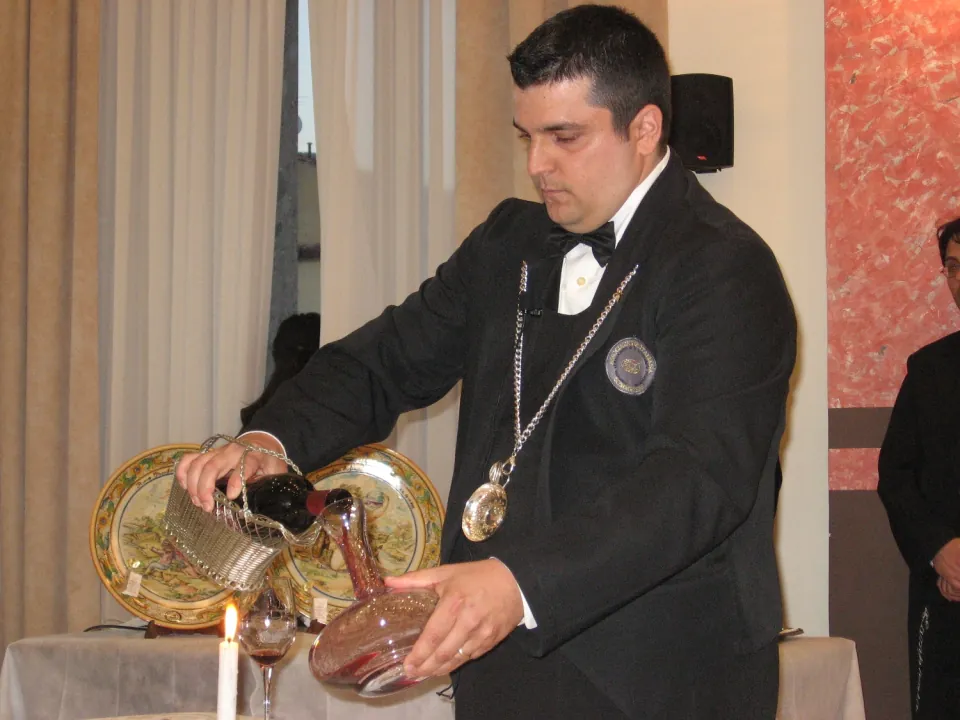
A carafe has two jobs. The first is air: a young, tannic red, a Barolo, a Syrah, seems rounder an hour or two after a vigorous pour, and a whiff of struck match blows off. The second is the sediment: a red that has lain ten or fifteen years has dropped pigments and tannins as a deposit. Stand the bottle upright a few hours before and pour in one steady movement against a light, the candle once, the phone’s torch today; as soon as the first haze reaches the neck, stop. Such wines are decanted only just before serving, because an old wine can fade quickly in air. Most whites need no carafe, and sparkling wine loses its carbon dioxide in one.
What a carafe cannot do
It does not age a young wine, because an hour of air is not ten years of cellar; it does not remove a cork taint; and it cools nothing, since pouring rather warms the wine. At home a thermometer, a bucket and a jug will do. And to learn how much temperature matters you need no study: pour the same red once straight from the cellar and once from the heated sitting room, and smell both glasses.