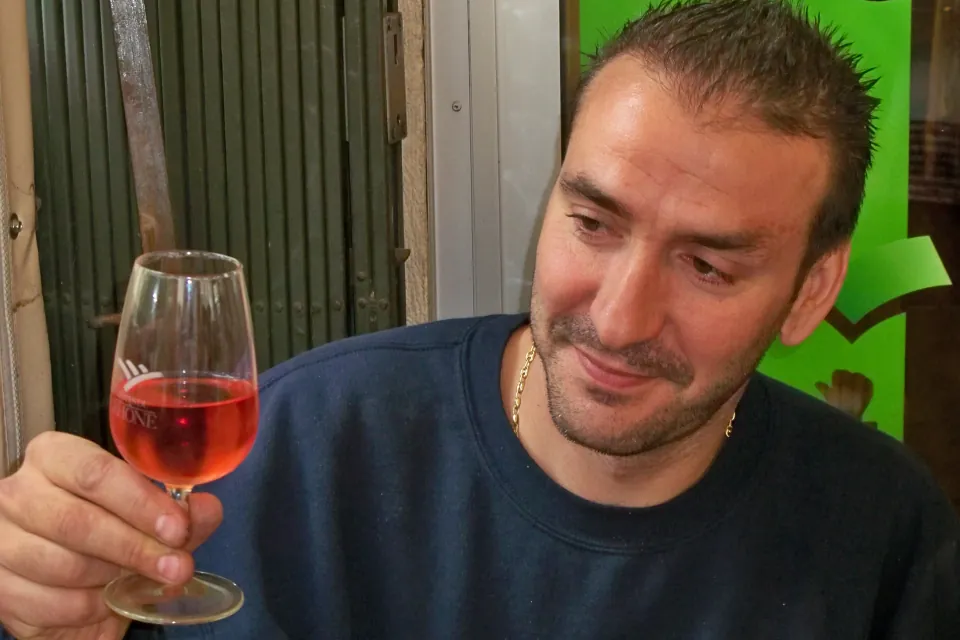
The glass arrives, and the taster tilts it over the white tablecloth, swirls, puts her nose in twice, slurps a sip, spits and writes a line. From the next table it looks like theatre. Yet every move has a job, and the wine schools teach them in a fixed order: the WSET’s Systematic Approach to Tasting runs through appearance, nose, palate and conclusions, on the grid that also sits behind the style profiles of this site’s grape pages.
The grid is not a poem; it is a form. Every wine gets the same lines, so that two tasters, or you on two evenings, can be compared, and each line demands a word, so that nothing gets skipped. The glass is part of the method too: a standard tasting glass with a small pour, so that only the wine changes.
To drop at the apéro
The tears on the glass betray alcohol, not quality: James Thomson explained them in 1855 by the alcohol that evaporates from the film on the glass wall faster than the water.
Step by step
- Look Tilt the glass over something white and look down through the wine: clarity, depth of colour at the core, hue at the rim. Young whites are lemon-green and turn gold, then amber; young reds purple, turning garnet with a brick rim.
- Swirl Two or three turns on the table, so the wine coats the wall: the thin film evaporates far faster than the wine below, and the bowl holds the vapour. Leave sparkling wine still.
- Smell Nose into the glass, two short sniffs. Is the wine clean? How intense, from light to pronounced? Then the aromas by origin: primary from the grape, secondary from the cellar, tertiary from age.
- Taste A sip that coats the whole mouth, with a little air drawn through it. Place the six scales: sweetness, acidity (the mouth waters), tannin (a drying grip on the gums), alcohol (warmth), body (weight), flavour intensity.
- Finish Swallow or spit and count how long the flavour stays: short, medium or long. Note what lingers: fruit and spice, or only alcohol and bitterness.
- Conclude Balance, length, intensity, complexity: how many of the four does the wine have? That sets the quality level. Drink now, or keep? Write it down before anyone tells you the price.
Why swirl, and why slurp?
Swirling spreads the wine into a thin film on the glass wall, and that is where it evaporates. The tears that then run down the wall, the engineer James Thomson explained in 1855: alcohol leaves the film faster than water, the surface tension rises and pulls wine up until drops fall back. Thick legs mean alcohol, not quality. The slurp works on the second door to the nose: the psychologist Paul Rozin set out in 1982 that smell is a double sense, sniffed or rising from the mouth as we swallow, and that we feel the second route as taste. Pinch your nose, and a great wine is sweet, sour, bitter and warm, nothing more.
The eye goes first
The order protects you from your own head. Gil Morrot, Frédéric Brochet and Denis Dubourdieu had 54 oenology students in Bordeaux describe a white wine dyed red with an odourless pigment, and they reached for red-wine words (2001): what the eye has decided, the nose confirms. The grid makes you commit before the label or the price can speak, and professionals taste blind. Swiss law asks the same: for every AOC the cantons must provide an organoleptic examination of the wine (wine ordinance, SR 916.140, Art. 21).
In your own glass
At home you need white paper, a glass filled to a third and, ideally, two wines side by side, because every scale is easier as a comparison: a Sauvignon Blanc for acidity, a Nebbiolo for tannin, a Pinot Noir to see how pale a serious red can be. Write six words per glass. After a dozen evenings the words come on their own.