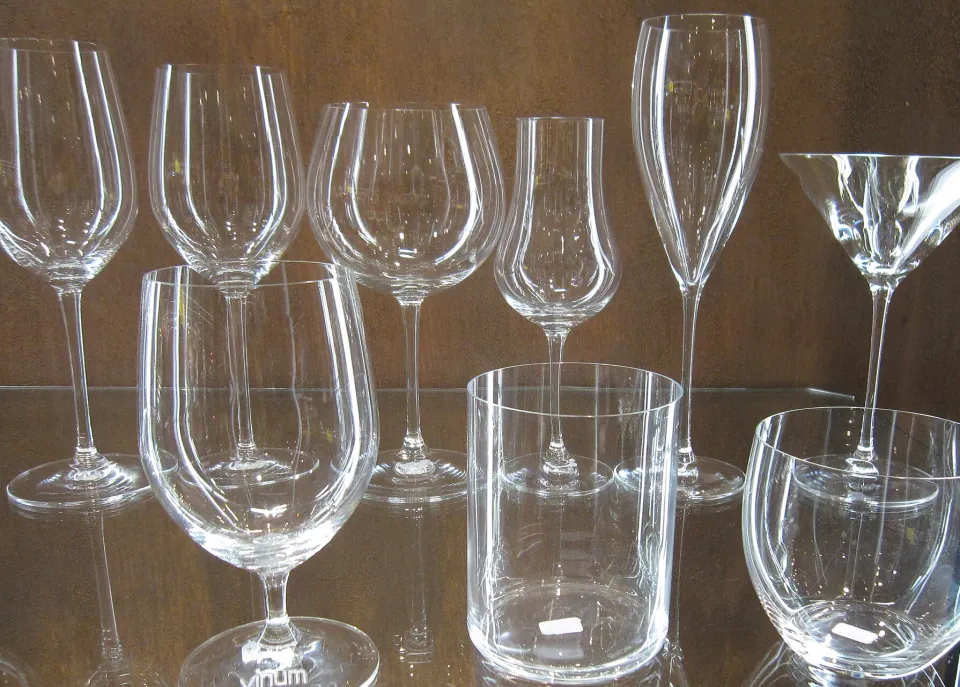
At the 1958 World’s Fair in Brussels, a glassmaker working in Kufstein, Tyrol, won the grand prize with a wine glass: a wide, thin, plain goblet for Burgundy. Claus Riedel went on to design a whole series, one shape for each kind of wine, and with it came a promise that has followed every wine glass since: the shape decides how the wine tastes. Shops now sell one glass for Pinot Noir, another for Riesling and a third for Champagne. How much of it holds up?
What the bowl does
Part of it is physics. A bowl wider than its rim gives the wine a large surface to evaporate from and, above it, a space that holds what rises; swirling draws the wine up the wall and keeps the supply coming. In Tokyo, Takahiro Arakawa and Kohji Mitsubayashi filmed this with a camera that makes ethanol vapour glow (2015): above a wine at 13 °C the alcohol gathered in a ring at the rim, and the centre, where the nose goes, held less; in a warmer wine, a cocktail glass or a straight tumbler there was no ring. The same idea shaped the tasting glass that the French INAO adopted in 1970 and ISO standardised in 1977: an elongated egg of 215 millilitres for a 50 millilitre pour, one glass for every wine, so that only the wine changes.
To drop at the apéro
In a lab test at 13 °C, the alcohol vapour above a wine glass gathered in a ring at the rim; in the centre, where the nose goes, there was less of it.
Blindfolded tasters
To see whether the shape does more, researchers blindfolded their tasters. In Canada, Margaret Cliff found that a Burgundy glass smelled more intense than the ISO glass, and the ISO glass more than a Chardonnay glass, but by a point or less on a scale of ten; intensity rose with how much wider the bowl was than its opening (2001). Jeannine Delwiche and Marcia Pelchat had novices smell one Cabernet Sauvignon from four glasses: it came out weaker only in the tall glass made for Cabernet (2002). In Dresden, with tasters who could see the glasses, Thomas Hummel’s team poured 181 people the same wine into three glasses without telling them, and they still rated its smell differently (2003). So the bowl changes the smell, a little. The claim from glass marketing that a rim steers wine to the sweet tip or the sour sides of the tongue is another matter: it rests on the tongue map, a misreading of measurements David Hänig published in 1901, and in 1974 Virginia Collings showed that every taste is sensed wherever she tested, with only small differences in sensitivity.
Which glass for which wine
For the table, what follows is simple. The flute shows off the bubbles, but Gérard Liger-Belair measured two to three times more carbon dioxide above it than above a coupe (2012), which the authors link to the prickle of a first sniff from a flute; many Champagne houses now prefer a tulip or a white-wine glass. In German-speaking Switzerland the order is still a Cüpli. Whites and rosés go into a medium bowl, poured small so they stay cool; reds into a larger one, the wide balloon for fragrant Pinot Noir and Nebbiolo, the taller Bordeaux glass, by tradition, for Cabernet Sauvignon and Merlot; port and sweet wines into a small glass, because the pour is small.
Almost every wine glass is wider in the bowl than at the rim
Eight shapes to one scale and the wines they are meant for. The exception is the coupe: it is widest at the rim.
-
Tasting glassReference
Every wine, for tasting
Opening 46 mm, bowl 65 mm, 155 mm tall; 215 ml for a 50 ml pour
-
Flute
Sparkling wine
Shows off the bubbles; carbon dioxide gathers above it
-
Tulip
Champagne and other sparkling wines
More room for the aroma than a flute
-
Coupe
Sparkling wine
The only glass here that is widest at the rim
-
White-wine glass
White wine and rosé
A medium bowl, poured small to keep the wine cool
-
Burgundy balloon
Fragrant reds
A wide bowl under a clearly narrower rim
-
Bordeaux glass
Tannic reds
Cabernet SauvignonMerlotBordeaux
A tall bowl; smelled blind, the wine came out a little weaker in it
-
Dessert-wine glass
Port and sweet wine
Small, because the pour is small
Schematic, except for the tasting glass, drawn to the ISO 3591 standard (1977). What the shape does: Cliff 2001, Delwiche and Pelchat 2002, Liger-Belair 2012.
At home, one good glass will do: clear and thin, on a stem, its bowl clearly wider than its rim and large enough to be filled only a third. Jancis Robinson launched just such a glass in 2018, one shape for everything from Champagne to port, and the Swiss critic René Gabriel had put his name to an all-purpose glass before her. If you want to know what your own glasses do, test them blind: have someone pour the same wine into two of them and hand them to you.