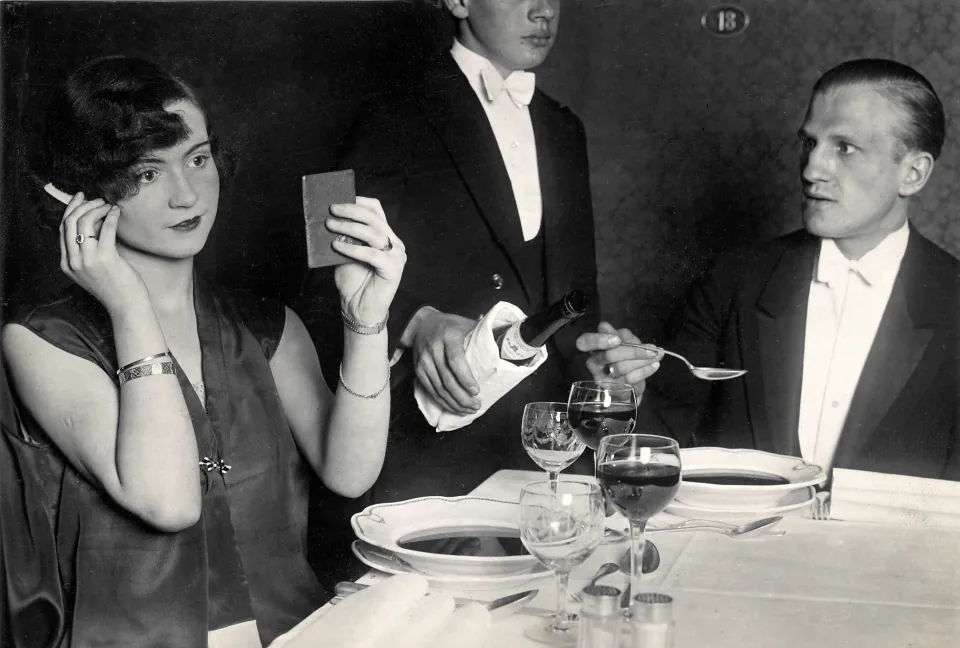
Hilke Plassmann and her colleagues at Caltech put volunteers into a brain scanner in 2008 and poured them Cabernet Sauvignon: the same wine came once as a 10-dollar bottle and once as a 90-dollar bottle. With the dear label it tasted better, and the orbitofrontal cortex, where the brain books pleasure, was busier. The price drinks along. On a date, though, only the person holding the list sees it; the other gets the wine, the gesture and the conversation. That is why what impresses at the table is not the expensive bottle but the steady hand: knowing what you want and saying it in two sentences.
Reading the list
A wine list is almost always built the same way: sparkling first, then white, rosé and red, and within a colour by country and region or by style from light to full. At the front stand the open wines, in Switzerland by the decilitre: one deci to try, two with the meal, and in German-speaking Switzerland a Cüpli is a glass of sparkling wine. This is the most honest part of the list: what is poured by the glass goes quickly, so it is fresh, and the owner chose it because it suits the kitchen. The legend that the second-cheapest bottle carries the biggest margin, because nobody dares order the cheapest, is proven nowhere. Only one thing is certain: a house with a short, annotated list usually knows its wines better than one with a book.
To drop at the apéro
In a brain scanner the same Cabernet tasted better with a 90-dollar label than with a 10-dollar one. On a date only one person sees the price: keep it to yourself.
Asking the sommelier
Asking is not an admission, it is the norm. Ben Dewald interviewed the people in charge of wine at 250 US fine-dining restaurants in 2008: guests asked for advice of their own accord 38 per cent of the time, and where a sommelier came to the table, 76 instead of 70 per cent of tables ordered wine. The question has a form every sommelier understands: what the two of you are eating, what you like, fresh rather than oaky, and a finger rested discreetly on a price on the list that suits you; that way nobody hears a number. Then the ritual: the bottle is shown, you check the name and vintage and nod; a sip is poured, to check, not to approve. If it smells of wet cardboard, the cork is to blame and the bottle goes back without discussion; if it smells of sherry and nuts, the wine is oxidised. A sound wine stays, even if it is not quite yours.
What really impresses
Not the price. Robin Goldstein and his colleagues analysed more than 6,000 blind tastings in 2008: people who did not know the price liked the dearer wines a shade less on average; only trained tasters liked them a little more. What impresses is making the wine part of the evening: a grape from the place one of you comes from, a Swiss Pinot Noir next to Burgundy, a Merlot from Ticino that the curse from “Sideways” never reached (in the United States the film dampened sales of cheap Merlot, as Steven Cuellar and his colleagues showed in 2009). Pour for the other person first, and little; say what you smell instead of lecturing; ask what they taste. The answer is almost always more interesting than the label.
You can practise before it counts. The printable quiz sheet “Date night” asks twelve questions from exactly this world, with the answers and their explanations on page 2. Print it twice, open a bottle, each of you ticks your own; whoever has more points chooses the wine next time. And in the restaurant, ask the sommelier at the end what they would drink tonight: it is the best question on the list.