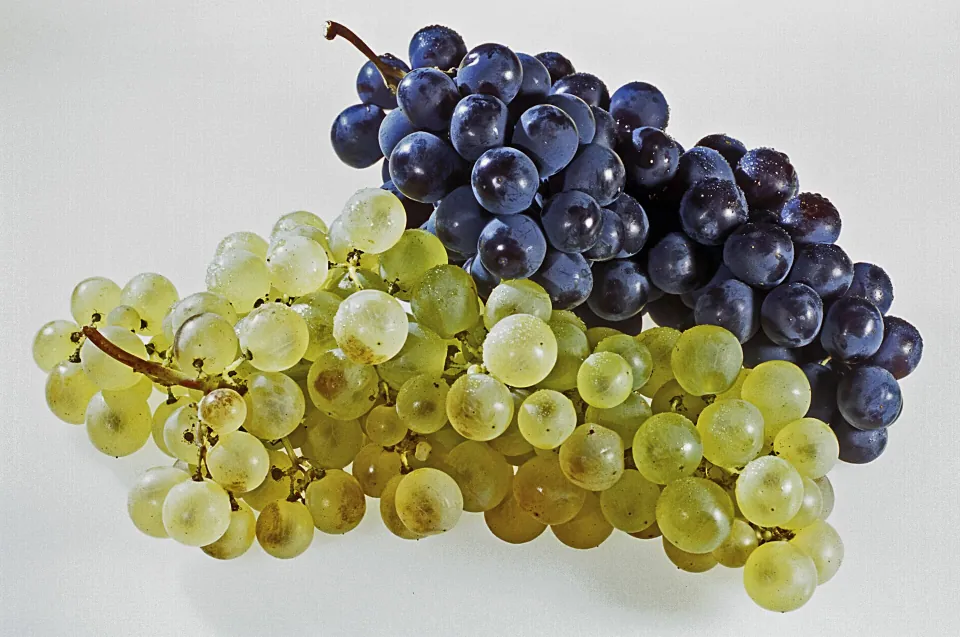
Every grape page on this site has a box called “In the glass”: six scales from the tasting grid of the Wine & Spirit Education Trust, the WSET, namely sweetness, acidity, tannin, alcohol, body and flavour intensity. Each of the 65 grapes gets a range on every scale, from its lightest typical wine to its richest. Take two scales as the axes, set each grape at the middle of its ranges, and a map appears. It is not measured but read from the standard descriptions, among them “Wine Grapes” by Jancis Robinson, Julia Harding and the Valais geneticist José Vouillamoz. Still, it shows which grapes are neighbours.

Among the whites the most useful pair is acidity and body, which hardly depend on each other: a full wine can be fresh or soft. So the whites fill all four corners. Fresh and light are Räuschling from Lake Zürich, Melon de Bourgogne from Muscadet and Riesling; fresh and full, Completer from Graubünden, Petite Arvine from Valais and Furmint. Soft and full are Viognier, Marsanne and Gewürztraminer, and the soft, light corner belongs to the classic whites of western and eastern Switzerland, Chasselas and Müller-Thurgau. Four of the five most planted whites sit on the fresh side; only Pinot Gris is soft.

To drop at the apéro

Chasselas, Switzerland’s most planted white grape, is the only one of 65 that stays at medium(−) or below for acidity, body and flavour intensity alike: the quietest grape on the map.

The big whites are fresh

White grapes by acidity and body, each at the middle of its typical ranges. Four of the five most planted sit on the fresh side; only Pinot Gris is soft.

lowmedium(−)mediummedium(+)highlightmedium(−)mediummedium(+)fullAcidity →Body →soft and lightfresh and lightsoft and fullfresh and fullRäuschlingRäuschling: Acidity high · Body light to medium(−)Melon de BourgogneMelon de Bourgogne: Acidity medium(+) to high · Body light to medium(−)CompleterCompleter: Acidity high · Body medium(+) to fullPetite ArvinePetite Arvine: Acidity medium(+) to high · Body medium(+) to fullFurmintFurmint: Acidity high · Body medium to fullViognierViognier: Acidity low to medium(−) · Body medium(+) to fullMarsanneMarsanne: Acidity low to medium(−) · Body medium(+) to fullGewürztraminerGewürztraminer: Acidity low to medium(−) · Body medium(+) to fullChasselasChasselas: Acidity low to medium(−) · Body light to medium(−)Müller-ThurgauMüller-Thurgau: Acidity low to medium(−) · Body light to medium(−)GleraGlera: Acidity medium to medium(+) · Body light to medium(−)MuscatMuscat: Acidity medium(−) to medium · Body light to fullChenin BlancChenin Blanc: Acidity high · Body medium(−) to fullVerdejoVerdejo: Acidity medium(+) · Body medium to medium(+)Grüner VeltlinerGrüner Veltliner: Acidity medium to medium(+) · Body medium(−) to fullVermentinoVermentino: Acidity medium to medium(+) · Body medium(−) to mediumSemillonSemillon: Acidity medium(−) to high · Body light to fullPinot BlancPinot Blanc: Acidity medium to medium(+) · Body medium(−) to medium(+)PalominoPalomino: Acidity low to medium(−) · Body medium(−) to fullGarganegaGarganega: Acidity medium to medium(+) · Body medium(−) to mediumAlbariñoAlbariño: Acidity medium(+) to high · Body medium(−) to mediumTorrontésTorrontés: Acidity medium(−) to medium · Body mediumSilvanerSilvaner: Acidity medium(−) to medium · Body medium(−) to fullAssyrtikoAssyrtiko: Acidity high · Body medium to medium(+)HeidaHeida: Acidity medium(+) to high · Body medium to fullNarinceNarince: Acidity medium to medium(+) · Body medium to medium(+)EmirEmir: Acidity medium(+) to high · Body light to medium(−)AmigneAmigne: Acidity medium to medium(+) · Body medium(+) to fullChardonnayChardonnay (one of the five most planted of its colour): Acidity medium to high · Body medium(−) to fullTrebbianoTrebbiano (Ugni Blanc) (one of the five most planted of its colour): Acidity medium(+) to high · Body light to medium(−)Sauvignon BlancSauvignon Blanc (one of the five most planted of its colour): Acidity medium(+) to high · Body medium(−) to mediumPinot GrisPinot Gris (one of the five most planted of its colour): Acidity medium(−) to medium · Body medium(−) to fullRieslingRiesling (one of the five most planted of its colour): Acidity high · Body light to medium(+)
  • The five most planted white grapes
  • Other grapes

Steps of the WSET tasting grid (Level 3, 2022), not measurements. Grapes on the same spot sit in a ring around it; every dot leads to its grape. Airén and Macabeo, which outrank Riesling worldwide, have no page here yet. Source: Weinquiz after WSET, the Oxford Companion and “Wine Grapes”.

Grip and freshness

For red wine the second question is tannin, and it too goes its own way. Nebbiolo and Aglianico have the top corner to themselves, high in both acidity and tannin: wines that need years. Barbera is just as fresh with hardly any grip, Pinot Noir and Gamay fresh and gentle. None of the five most planted reds is reliably fresh: Cabernet Sauvignon, Merlot, Tempranillo and Syrah sit in the firm middle, and Grenache alone holds the low corner of both scales, soft, round and warm.

Freshness belongs to the specialists

Red grapes by acidity and tannin. None of the five most planted is reliably fresh: the right-hand side belongs to Nebbiolo, Barbera, Pinot Noir and Gamay.

lowmedium(−)mediummedium(+)highlowmedium(−)mediummedium(+)highAcidity →Tannin →soft and gentlefresh and gentlesoft and firmfresh and firmNebbioloNebbiolo: Acidity high · Tannin highAglianicoAglianico: Acidity high · Tannin highBarberaBarbera: Acidity high · Tannin low to medium(−)Pinot NoirPinot Noir: Acidity medium(+) to high · Tannin low to mediumGamayGamay: Acidity medium(+) to high · Tannin low to medium(−)MourvèdreMourvèdre: Acidity medium(−) to medium · Tannin medium(+) to highSangioveseSangiovese: Acidity medium(+) to high · Tannin medium to highMalbecMalbec: Acidity medium to medium(+) · Tannin medium(−) to highCabernet FrancCabernet Franc: Acidity medium(+) to high · Tannin medium(−) to medium(+)MontepulcianoMontepulciano: Acidity medium(−) to medium · Tannin medium(−) to medium(+)ZinfandelZinfandel: Acidity medium(−) to medium · Tannin medium(−) to mediumPinot MeunierPinot Meunier: Acidity medium(+) to high · Tannin low to medium(−)Nero d’AvolaNero d’Avola: Acidity medium(−) to medium · Tannin medium(−) to mediumBlaufränkischBlaufränkisch: Acidity medium(+) to high · Tannin medium to medium(+)CarmenèreCarmenère: Acidity medium(−) to medium · Tannin medium(−) to mediumTouriga NacionalTouriga Nacional: Acidity medium to medium(+) · Tannin medium(+) to highZweigeltZweigelt: Acidity medium · Tannin low to medium(−)CorvinaCorvina: Acidity medium(+) to high · Tannin low to medium(+)PinotagePinotage: Acidity medium to medium(+) · Tannin medium to medium(+)ÖküzgözüÖküzgözü: Acidity medium(+) to high · Tannin low to medium(−)BoğazkereBoğazkere: Acidity medium to medium(+) · Tannin highKalecik KarasıKalecik Karası: Acidity medium · Tannin low to medium(−)GamaretGamaret: Acidity medium · Tannin medium(+) to highGaranoirGaranoir: Acidity medium(−) to medium · Tannin medium(−) to mediumCornalinCornalin: Acidity medium to medium(+) · Tannin medium to medium(+)Humagne RougeHumagne Rouge: Acidity medium · Tannin medium to medium(+)DiolinoirDiolinoir: Acidity medium to medium(+) · Tannin medium(+) to highCabernet SauvignonCabernet Sauvignon (one of the five most planted of its colour): Acidity medium to high · Tannin medium(+) to highMerlotMerlot (one of the five most planted of its colour): Acidity medium(−) to medium · Tannin medium(−) to medium(+)TempranilloTempranillo (one of the five most planted of its colour): Acidity medium(−) to medium · Tannin medium to highSyrahSyrah (one of the five most planted of its colour): Acidity medium to medium(+) · Tannin medium to highGrenacheGrenache (one of the five most planted of its colour): Acidity low to medium · Tannin low to medium
  • The five most planted red grapes
  • Other grapes

Steps of the WSET tasting grid (Level 3, 2022), not measurements. Grapes on the same spot sit in a ring around it; every dot leads to its grape. Source: Weinquiz after WSET, the Oxford Companion and “Wine Grapes”.

What goes together

Not every pair makes a map. Plot the whites’ alcohol against their body, or the reds’ tannin against theirs, and the dots climb a diagonal; the three reds that are always high in alcohol, Grenache, Zinfandel and Mourvèdre, are all at least medium-bodied. That is no coincidence: alcohol is much of what the palate reads as body. In 2007 an Australian team led by Richard Gawel raised the alcohol of three Rieslings from 11.6 to 13.6 per cent, and in two of them the tasters found the wine fuller and more viscous. Glycerol, often credited with a wine’s weight, had a weaker and less consistent effect.

More alcohol, more body

Above, the white grapes by alcohol and body; below, the reds by tannin and body: the dots rise together, and the dashed line shows the trend.

White grapes: alcohol and body

lightmedium(−)mediummedium(+)fulllowmediumhighBody →Alcohol →GleraGlera: Body light to medium(−) · Alcohol low to mediumMuscatMuscat: Body light to full · Alcohol low to highChenin BlancChenin Blanc: Body medium(−) to full · Alcohol medium to highVerdejoVerdejo: Body medium to medium(+) · Alcohol medium to highGrüner Veltliner: Body medium(−) to full · Alcohol medium to highMüller-ThurgauMüller-Thurgau: Body light to medium(−) · Alcohol low to mediumVermentinoVermentino: Body medium(−) to medium · Alcohol medium to highSemillonSemillon: Body light to full · Alcohol low to highPinot Blanc: Body medium(−) to medium(+) · Alcohol mediumPalominoPalomino: Body medium(−) to full · Alcohol highGewürztraminerGewürztraminer: Body medium(+) to full · Alcohol medium to highViognierViognier: Body medium(+) to full · Alcohol medium to highGarganegaGarganega: Body medium(−) to medium · Alcohol mediumAlbariñoAlbariño: Body medium(−) to medium · Alcohol mediumMelon de BourgogneMelon de Bourgogne: Body light to medium(−) · Alcohol mediumTorrontés: Body medium · Alcohol medium to highSilvaner: Body medium(−) to full · Alcohol medium to highChasselas: Body light to medium(−) · Alcohol mediumFurmintFurmint: Body medium to full · Alcohol low to highAssyrtikoAssyrtiko: Body medium to medium(+) · Alcohol medium to highMarsanne: Body medium(+) to full · Alcohol medium to highHeida: Body medium to full · Alcohol medium to highNarinceNarince: Body medium to medium(+) · Alcohol mediumPetite ArvinePetite Arvine: Body medium(+) to full · Alcohol medium to highEmirEmir: Body light to medium(−) · Alcohol mediumAmigneAmigne: Body medium(+) to full · Alcohol medium to highRäuschlingRäuschling: Body light to medium(−) · Alcohol mediumCompleter: Body medium(+) to full · Alcohol medium to highChardonnayChardonnay (one of the five most planted of its colour): Body medium(−) to full · Alcohol medium to highTrebbianoTrebbiano (Ugni Blanc) (one of the five most planted of its colour): Body light to medium(−) · Alcohol low to mediumSauvignon BlancSauvignon Blanc (one of the five most planted of its colour): Body medium(−) to medium · Alcohol mediumPinot GrisPinot Gris (one of the five most planted of its colour): Body medium(−) to full · Alcohol medium to highRieslingRiesling (one of the five most planted of its colour): Body light to medium(+) · Alcohol low to medium

Red grapes: tannin and body

lightmedium(−)mediummedium(+)fulllowmedium(−)mediummedium(+)highBody →Tannin →Pinot NoirPinot Noir: Body light to medium · Tannin low to mediumSangioveseSangiovese: Body medium to full · Tannin medium to highMalbecMalbec: Body medium(+) to full · Tannin medium(−) to highCabernet FrancCabernet Franc: Body medium(−) to medium(+) · Tannin medium(−) to medium(+)MourvèdreMourvèdre: Body medium(+) to full · Tannin medium(+) to highMontepulcianoMontepulciano: Body medium to medium(+) · Tannin medium(−) to medium(+)ZinfandelZinfandel: Body medium to full · Tannin medium(−) to mediumGamayGamay: Body light to medium · Tannin low to medium(−)Pinot MeunierPinot Meunier: Body light to medium(−) · Tannin low to medium(−)Nero d’AvolaNero d’Avola: Body medium(+) to full · Tannin medium(−) to mediumBarberaBarbera: Body medium(−) to medium(+) · Tannin low to medium(−)BlaufränkischBlaufränkisch: Body medium to full · Tannin medium to medium(+)CarmenèreCarmenère: Body medium to medium(+) · Tannin medium(−) to mediumTouriga NacionalTouriga Nacional: Body medium(+) to full · Tannin medium(+) to highAglianicoAglianico: Body medium(+) to full · Tannin highZweigeltZweigelt: Body medium(−) to medium · Tannin low to medium(−)NebbioloNebbiolo: Body medium to full · Tannin highCorvinaCorvina: Body medium(−) to full · Tannin low to medium(+)PinotagePinotage: Body medium to full · Tannin medium to medium(+)ÖküzgözüÖküzgözü: Body medium · Tannin low to medium(−)BoğazkereBoğazkere: Body medium(+) to full · Tannin highKalecik Karası: Body medium(−) to medium · Tannin low to medium(−)GamaretGamaret: Body medium to medium(+) · Tannin medium(+) to highGaranoirGaranoir: Body medium · Tannin medium(−) to mediumCornalinCornalin: Body medium to medium(+) · Tannin medium to medium(+)Humagne RougeHumagne Rouge: Body medium · Tannin medium to medium(+)DiolinoirDiolinoir: Body medium to medium(+) · Tannin medium(+) to highCabernet SauvignonCabernet Sauvignon (one of the five most planted of its colour): Body medium to full · Tannin medium(+) to highMerlotMerlot (one of the five most planted of its colour): Body medium to full · Tannin medium(−) to medium(+)TempranilloTempranillo (one of the five most planted of its colour): Body medium to full · Tannin medium to highSyrahSyrah (one of the five most planted of its colour): Body medium to full · Tannin medium to highGrenacheGrenache (one of the five most planted of its colour): Body medium to full · Tannin low to medium
  • The five most planted red grapes
  • The five most planted white grapes
  • Other grapes

Each dot is a grape at the middle of its ranges and leads to it. Source: Weinquiz after the WSET tasting grid (Level 3, 2022).

A net instead of a dot

A spider chart, one spoke per scale, shows all six at once. Here the five most planted grapes of each colour are bands from their lightest style to their richest, and the width of a band tells the story: Riesling stretches from dry to luscious, as Chenin Blanc, Furmint, Muscat and Gewürztraminer do, while Sauvignon Blanc, almost always dry, fresh and aromatic, is the narrowest of the ten. Read the shape, not the area: alcohol has three steps where sweetness has six, and the order of the spokes alone changes the area.

The big ones as spiders

The five most planted red and white grapes. Each band runs from the lightest typical wine to the richest: Riesling has the broadest, Sauvignon Blanc the narrowest.

  • SweetnessAcidityTanninAlcoholBodyIntensityOne spoke per scale: the lowest step at the centre, the highest at the rim.

Red grapes

White grapes

Read the shape, not the area: alcohol has three steps where sweetness has six, and the order of the spokes alone changes the area. White grapes have no tannin; their band runs past the dashed spoke. A ring: a sweet style apart from the dry wines. Source: Weinquiz after the WSET tasting grid.

Everywhere or only at home

How much there is of each grape, a last chart shows, from the University of Adelaide’s database compiled by the economist Kym Anderson with Signe Nelgen and Germán Puga. The most planted is Cabernet Sauvignon, with 279,000 hectares in 46 countries, the most widespread Chardonnay, in 47. Tempranillo has almost as much land, 227,000 hectares, but in only 20 countries, most of it in Spain. Thirteen of the 65 grow in a single country: five Turkish grapes and eight Swiss, the smallest Completer with 11 hectares. For the glass, the maps give one rule: if you like a wine, try its neighbour; every grape page shows its three closest on the map of its colour.

Everywhere or only at home

Each grape’s vineyard area worldwide (on a log scale: each line ten times the one before) against the number of countries with at least a hectare of it.

101001,00010,000100,00011020304050World vineyard area, hectares →Countries →CompleterCompleter: 11 ha in one countryPetite ArvinePetite Arvine: 254 ha in one countryCornalinCornalin: 161 ha in one countryRäuschlingRäuschling: 27 ha in one countryPinot NoirPinot Noir: 132,000 ha in 42 countriesSangioveseSangiovese: 66,800 ha in 17 countriesMalbecMalbec: 60,400 ha in 17 countriesCabernet FrancCabernet Franc: 45,300 ha in 32 countriesMourvèdreMourvèdre: 44,100 ha in 12 countriesGleraGlera: 42,000 ha in 6 countriesMuscatMuscat: 36,100 ha in 29 countriesMontepulcianoMontepulciano: 30,900 ha in 8 countriesChenin BlancChenin Blanc: 30,900 ha in 18 countriesZinfandelZinfandel: 30,700 ha in 11 countriesVerdejoVerdejo: 25,300 ha in 3 countriesGamay: 23,100 ha in 15 countriesPinot Meunier: 23,000 ha in 15 countriesNero d’AvolaNero d’Avola: 20,200 ha in 4 countriesBarberaBarbera: 19,700 ha in 10 countriesGrüner Veltliner: 19,100 ha in 12 countriesMüller-ThurgauMüller-Thurgau: 18,400 ha in 17 countriesVermentino: 18,100 ha in 8 countriesSemillonSemillon: 17,000 ha in 21 countriesPinot BlancPinot Blanc: 16,500 ha in 27 countriesBlaufränkisch: 15,700 ha in 15 countriesCarmenère: 14,800 ha in 9 countriesPalomino: 14,200 ha in 7 countriesGewürztraminerGewürztraminer: 14,100 ha in 29 countriesTouriga Nacional: 13,600 ha in 9 countriesViognierViognier: 13,600 ha in 23 countriesGarganega: 13,400 ha in 3 countriesAlbariño: 10,700 ha in 9 countriesAglianico: 9,600 ha in 5 countriesMelon de Bourgogne: 8,590 ha in 2 countriesZweigelt: 8,480 ha in 16 countriesTorrontés: 7,910 ha in 3 countriesNebbioloNebbiolo: 7,360 ha in 9 countriesCorvinaCorvina: 7,360 ha in 3 countriesPinotagePinotage: 6,630 ha in 5 countriesSilvanerSilvaner: 6,250 ha in 11 countriesChasselas: 6,180 ha in 12 countriesFurmintFurmint: 4,220 ha in 7 countriesAssyrtiko: 2,160 ha in 2 countriesÖküzgözüÖküzgözü: 1,600 ha in one country (2016)MarsanneMarsanne: 1,450 ha in 9 countriesBoğazkere: 1,440 ha in one country (2016)HeidaHeida: 1,340 ha in 5 countriesNarince: 787 ha in one country (2016)Kalecik Karası: 704 ha in one country (2016)Gamaret: 481 ha in 4 countriesGaranoir: 230 ha in one countryHumagne Rouge: 142 ha in one countryDiolinoir: 130 ha in one countryEmirEmir: 89 ha in one country (2016)Amigne: 40 ha in one countryCabernet SauvignonCabernet Sauvignon: 279,000 ha in 46 countries (one of the five most planted of its colour)MerlotMerlot: 258,000 ha in 46 countries (one of the five most planted of its colour)TempranilloTempranillo: 227,000 ha in 20 countries (one of the five most planted of its colour)ChardonnayChardonnay: 223,000 ha in 47 countries (one of the five most planted of its colour)SyrahSyrah: 189,000 ha in 41 countries (one of the five most planted of its colour)GrenacheGrenache: 161,000 ha in 21 countries (one of the five most planted of its colour)TrebbianoTrebbiano (Ugni Blanc): 149,000 ha in 18 countries (one of the five most planted of its colour)Sauvignon BlancSauvignon Blanc: 144,000 ha in 43 countries (one of the five most planted of its colour)Pinot GrisPinot Gris: 67,900 ha in 29 countries (one of the five most planted of its colour)RieslingRiesling: 53,400 ha in 35 countries (one of the five most planted of its colour)
  • The five most planted red grapes
  • The five most planted white grapes
  • Other grapes

Bearing area around 2023; Turkey has reported nothing since 2016. A country counts with at least one hectare of the grape; Airén and Macabeo, two large white grapes, have no page here yet. Source: Anderson, Nelgen and Puga, University of Adelaide (2026).